Day One Morning: Walking into History
Kinsale announces itself before you've finished parking. The town's name in Irish — Cionn tSáile, roughly translated as Headland of the Sea — tells you exactly where you are: at the edge of a natural harbour where the River Bandon meets the Atlantic, a strategic position that made this small Cork town one of the most contested pieces of ground in Irish history. Early records date the settlement to the 12th century, and in 1333 the town was granted its first charter. By the 16th and 17th centuries, it had become the most utilised natural harbour in Ireland for the shipping trade — a fact that made it both wealthy and enormously consequential.
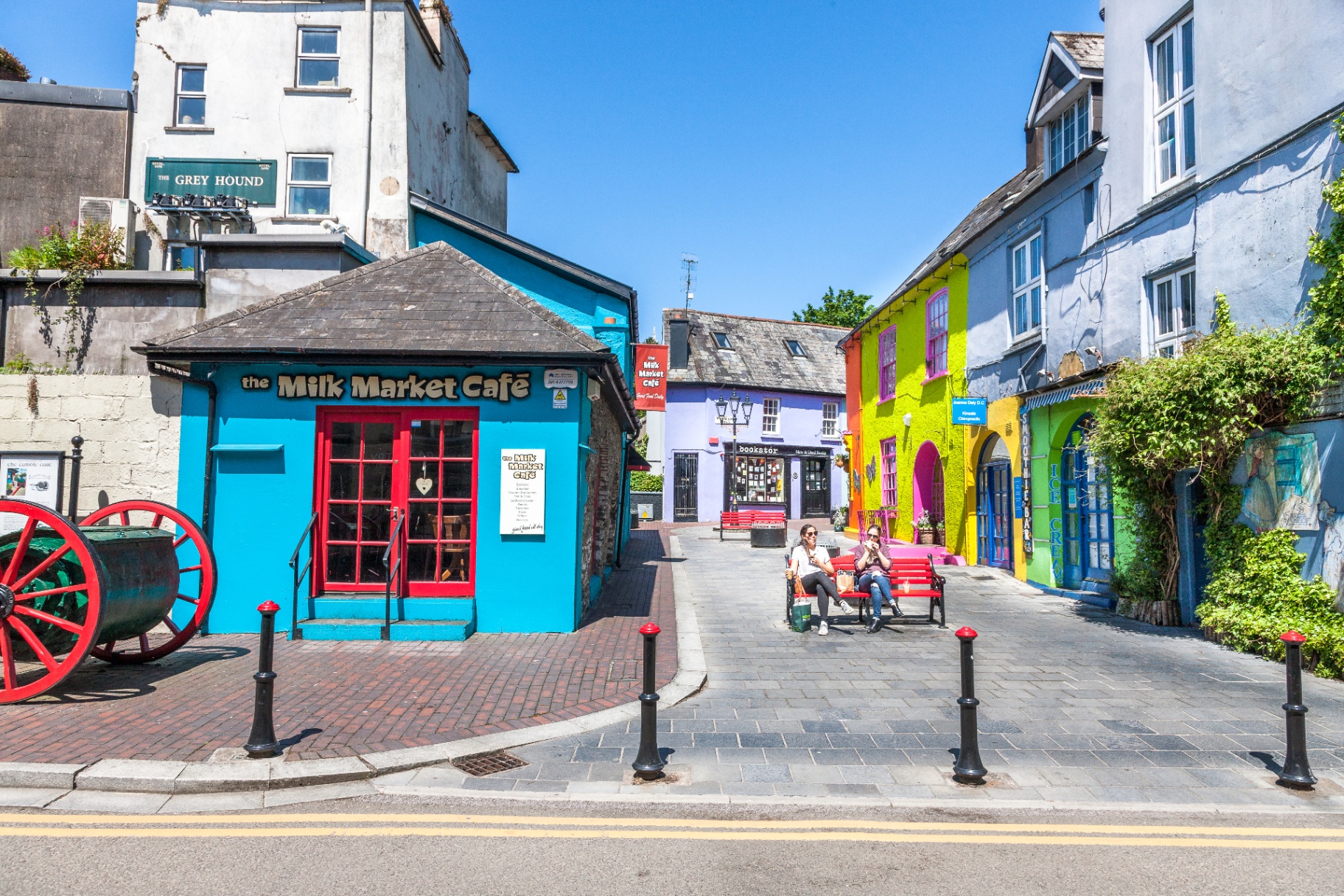
The place to begin is St Multose Church on Church Street, one of the oldest Church of Ireland churches in the country, built around 1190 by the Normans on the site of a 6th-century church. The tower, the Romanesque doorway and the atmosphere of accumulated centuries — marriages, funerals, sieges, occupations, all absorbed into its stone walls — make it one of those Irish churches that rewards ten minutes of quiet as much as anything more structured. From there, follow the maze of streets uphill toward the Market Square, where the colourful painted facades of Kinsale's characteristic townhouses — three-storey Georgian and Victorian buildings in ochre, terracotta, slate blue and cream — make almost every corner feel like a deliberate composition.
The Courthouse and Regional Museum on Market Square is worth a stop for a specific reason that goes well beyond its exhibits on the Battle of Kinsale. This building — constructed around 1600 with additions in 1706 — was the location of the inquest into the sinking of the RMS Lusitania on Monday 10 May 1915, four days after the Cunard ocean liner was torpedoed by German U-boat U-20 off the Old Head of Kinsale with the loss of 1,198 lives. The survivors were brought to Kinsale. The inquest was held here. Three of the victims are buried in the churchyard of St Multose. Standing in a room where that piece of history was formally recorded gives it a weight that the standard maritime museum format rarely achieves.
Day One Afternoon: Desmond Castle and the Harbour Walk
Desmond Castle on Cork Street is one of Kinsale's oldest surviving structures — a fortified tower house built around 1500 by Maurice Bacach Fitzgerald, Earl of Desmond. It has served variously as a customs house, an arsenal for the Spanish forces during the Siege of Kinsale in 1601, a prison for American privateers during the American War of Independence, and a workhouse during the Great Famine. Today it operates as the International Museum of Wine, reflecting Kinsale's long-standing connection to the European wine trade — a surprising dimension of the town's history that the museum documents with genuine depth. Entry costs are modest and the guided tour provides essential context for understanding how a small Cork port came to sit at the centre of transatlantic and European commercial networks for three centuries.
After the castle, follow the harbour front south toward Summercove. The walk from Kinsale town along the estuary to Summercove takes approximately forty minutes on foot and the views across the water — boats at their moorings, the estuary opening westward, the hills of the opposite shore — are the kind that make you slow down without meaning to. The destination is Charles Fort, built during the 1670s and 1680s and named in honour of King Charles II. One of the best-preserved star-shaped artillery forts in Europe, it played a critical role in the Williamite War of 1690 and remained a military installation until Irish independence. Though parts were burned in 1922, significant restoration work has brought it back to a state that allows visitors to walk its full extent — bastions, barracks, magazines and all — while absorbing views across Kinsale Harbour that are, on a clear summer afternoon, difficult to improve upon. Charles Fort was declared a National Monument in 1973 and is managed by the Office of Public Works.
Day One Evening: Dinner in a Town That Takes Food Seriously
Kinsale's reputation as a food destination is well-established and well-earned, built over decades through a combination of proximity to exceptional local produce — seafood from the Atlantic, meat from Cork's pastoral hinterland, dairy that reflects the county's grassland farming tradition — and a density of serious restaurants for a town of its size.
Fishy Fishy, on Crowley's Quay, is one of the most recognised seafood restaurants in Munster — a bright, informal room built around the principle that fresh local fish treated simply is all you need. The daily menu reflects what has actually been landed that day rather than what is convenient to stock, and the combination of hake, monkfish, crab, prawns and oysters from the local waters with a wine list that takes the matching seriously makes it the first port of call for most food-focused visitors. The restaurant opens for lunch and dinner from Tuesday to Sunday.
For those who prefer a more casual evening, The Bulman in Summercove, walking distance from Charles Fort, is a pub that trades on two things: its position looking out over the harbour and its seafood chowder, which is one of those dishes that regular visitors mention without prompting as among the best versions they have encountered in Cork. The views at sunset from the Bulman's terrace, with the water turning copper and the fort visible across the cove, are one of those Irish experiences that a photograph will only partially justify.
Day Two Morning: The Battle Site and the Old Head
The Battle of Kinsale, fought on 24 December 1601, was one of the decisive events in Irish history. A Spanish fleet of 28 ships under Don Juan del Águila had occupied Kinsale in September 1601, and Hugh O'Neill and Red Hugh O'Donnell marched south from Ulster in the depths of winter to relieve the siege and combine forces against the English under Charles Blount, Lord Mountjoy. The attempt failed. The English held their ground, the Irish and Spanish coordination broke down under pressure, and the battle was over within hours. The Flight of the Earls that followed — O'Neill and the remaining Gaelic lords leaving Ireland forever in 1607 — is widely understood as marking the end of the old Gaelic order and the consolidation of English rule across the island. A monument marks the general site of the battle approximately four miles northwest of the town. For anyone with an interest in the course of Irish history, standing at that location and understanding what it meant carries a weight that no classroom account quite prepares you for.
From the town, the Old Head of Kinsale is a fifteen-minute drive south — a narrow promontory jutting into the Atlantic that is one of the most dramatic pieces of coastline in County Cork. The Old Head Signal Tower and Lusitania Museum, a 200-year-old signal tower at the promontory's narrowest point, houses a museum dedicated to the Lusitania and its loss, complementing the courthouse inquest connection in town with a more expansive account of the disaster and its international consequences, including the United States' eventual entry into the First World War. The cliff walk around the Old Head on the public right of way is one of the finest coastal walks in south Cork, with the sea visible on three sides and, on a clear day, the Fastnet Rock lighthouse visible to the west.
Day Two Afternoon: Blacks Brewery and the Town's Craft Culture
Kinsale's contemporary character sits alongside its history without apology. Blacks of Kinsale, the craft brewery and distillery operating in the town, produces a range of beers, rum and gin that has gained a following well beyond County Cork. The brewery tours are informative and entertaining, and the combination of tasting the products in the space where they are made and understanding the specific local ingredients and methods involved gives a Blacks visit a dimension that a pub tasting alone cannot replicate. Their beers are available across the town but trying them at source, in the barrel-stocked tasting room, is the better version of the experience.
The town's café culture rewards unhurried exploration. The Collector, a specialty coffee bar, cocktail lab and curated shop, has built a following since opening in 2023 that reflects the quality of its sourcing and preparation. O'Herlihys on Pearse Street does brunch and baked goods of the kind that make it difficult to leave. Poets Corner on Main Street — a café and bookshop with a book exchange — is exactly the kind of place that small Irish towns used to produce with more regularity and that makes Kinsale feel like somewhere people have thought carefully about what they want their town to be.
Before leaving, walk the Scilly Walk — the coastal path running from the town's Lower Road along the water's edge toward Summercove — which gives a final, unhurried view of the harbour and its boats, the town's colourful rooftops above the quay, and the estuary widening southward toward the sea. It is the right way to leave Kinsale: on foot, with the water beside you, and the town looking its best from the outside.
The Bottom Line
Kinsale holds more history per square kilometre than almost anywhere else in Munster — four centuries of it, from the battle that changed Ireland's political course in 1601 to the inquest that helped bring America into the First World War in 1915. It pairs that history with a harbour, a food scene built on excellent local produce, a craft brewery worth the detour, and a walkable, compact character that rewards two full days without ever feeling like you've run out of reasons to stay.