Why Doolin Is Different
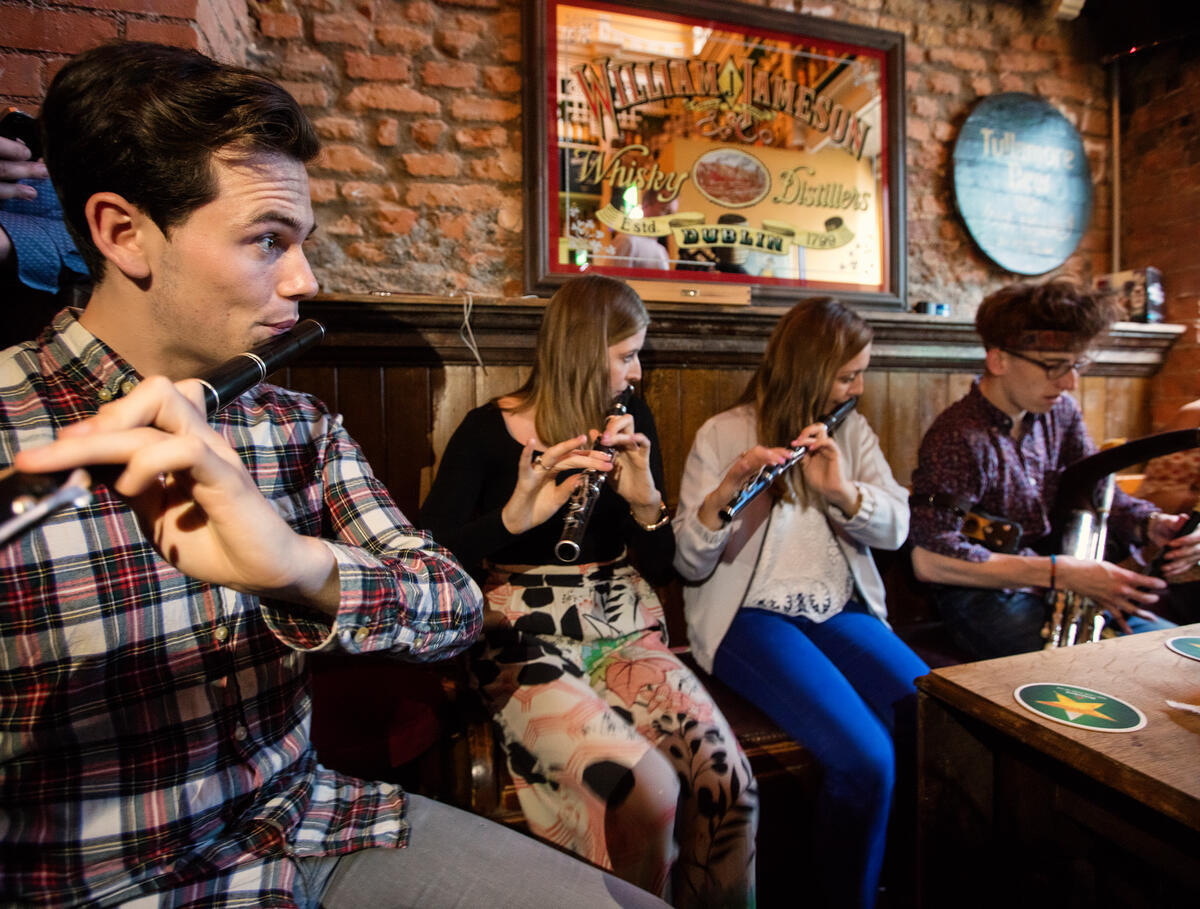
There are hundreds of pubs in Ireland that host traditional music sessions, and many of them are excellent. What makes Doolin different is not the quality of any individual session on any given night — though that quality is consistently high — but the totality of what the village has accumulated over nearly a century of musical life. Folklore collectors and archivists were coming to Doolin and its pubs as early as the 1930s, drawn by the density of musical talent in this small cluster of houses on the north Clare coast. The musicians they found, the repertoire they recorded, and the tradition they documented were not a performance put on for visitors — they were the living everyday culture of a community that had always played, and whose music had developed in relative isolation into something identifiable and distinct.
That distinctiveness has a name. The Doolin style of traditional music — characterised by a particular rhythmic drive, a preference for certain Clare-specific tune settings, and a directness of phrasing associated with the area's flute, fiddle and uilleann pipe players — is widely understood within the trad music world as one of Ireland's most influential regional traditions. Its most famous custodians were three brothers: Micho, Packie and Gussie Russell, who played at Gus O'Connor's pub and whose recordings and influence helped spread the Doolin style far beyond its home village. Their legacy is still formally celebrated every year on the last weekend of February at a traditional music festival held in their honour at O'Connor's — evidence that the culture is maintained by the community itself, not just preserved for visitors.
The Three Pubs: The Trinity of Doolin Music
Doolin is a small village — a fifteen-minute walk from one end to the other — and its traditional music scene revolves around four pubs, three of which are generally described by musicians and regular visitors as the classic Doolin pub trinity: Gus O'Connor's, McDermott's and McGann's.
Gus O'Connor's on Fisher Street is the oldest and most historically significant. Established in 1832, it has been hosting musicians for nearly two centuries and runs sessions seven evenings a week from February to November, with weekend sessions year-round. The pub's session philosophy is deliberately open and inclusive — no individual microphones, no separation between musicians and audience, just a shared space in which music happens collectively and anyone who can play is welcome to join in. It is as close to a living museum of the trad session tradition as you will find anywhere in Ireland, and yet it functions as a working pub in every sense, with a roaring fire in winter and the smell of Guinness and woodsmoke in the air.
McDermott's has been family-run for four generations since 1887, and live music kicks off nightly around 8:30pm and carries on until late. The session format is the real thing — musicians and audience shoulder to shoulder, fiddles and bodhráns in close quarters, the sound filling the room without amplification in a way that recorded music never quite captures. Regulars advise arriving early to get a seat near the music, and the food — particularly the fish and chips, which won a formal award — is worth the detour in its own right.
McGann's was founded in 1975 by brothers Tommy and Tony McGann, who returned from the United States with, as one regular put it, "a dream and a load of Irish grit." Still run by the next generation — Sheila and Dermot — it has built a reputation that is warmly regarded among musicians who pass through, with world-class players regularly tucking into a corner and drawing locals and visitors into that familiar foot-tapping trance without ceremony or announcement. The music is central, the atmosphere is genuine, and Tony's famous beef stew remains the stuff of local legend.
Fitzpatrick's Bar, located in Hotel Doolin, completes the circuit. It is arguably best known for hosting live music sessions every single day of the year — 365 days without exception — a commitment that is extraordinary in a village of Doolin's size and one that ensures there is never a night when music is absent from the village, regardless of the season.
The Russell Brothers and Why They Matter
No account of Doolin's music is complete without understanding the Russell brothers. Micho Russell was a flute player, sean-nós singer and storyteller whose recorded output — made in his kitchen as much as in any studio — became foundational texts for anyone studying Clare traditional music. Packie Russell played the fiddle and tin whistle, Gussie the uilleann pipes. Together, and individually, they were regular presences at Gus O'Connor's from the mid-20th century onward, and the musicians who came to hear them, stayed to play with them, and went home carrying their tunes and their approach to rhythm, spread the Doolin style across the trad music world in a way that would have been impossible without the particular intimacy of the pub session format. In the immortal words of Christy Moore — himself a regular visitor to Doolin — "If it's music you want, you should go to Clare." He was not wrong, and the Russell brothers are the primary reason that statement carries weight.
The Setting: Where Doolin Actually Is
Understanding Doolin's geography makes the experience richer. The village sits on the Atlantic coast at the northern edge of the Cliffs of Moher, with Black Head and the Burren's limestone landscape rising to the north and east. It is small, genuinely rural in character, and perched at the edge of the country in a way that gives it the quality of a destination rather than a through-route. It is also one of two main departure points for ferries to the Aran Islands — Inis Mór, Inis Meáin and Inis Oírr — which sit on the horizon to the west and add a further dimension to a visit. Walking the coastal cliff path from Doolin toward the Cliffs of Moher in the morning and returning to a session in O'Connor's or McDermott's in the evening is the kind of Irish day that doesn't need any embellishment.
The village is small enough that there is no bad approach to a trad session here. Just pick a pub and walk in. The music will find you. County Clare has been described by commentators as the home of traditional Irish music in Ireland, and in 2026 Doolin remains its beating heart.
The Bottom Line: A trad session in Doolin isn't something you can replicate elsewhere, because what makes it what it is — the deep roots, the Russell legacy, the continuity of the community's musical life stretching back almost a century before the first visitor arrived specifically to hear it — is not portable. You have to go. Walk into O'Connor's or McDermott's or McGann's, order a pint, find a seat near the music, and let the evening take the shape it wants to take. That is the whole plan. It is enough.