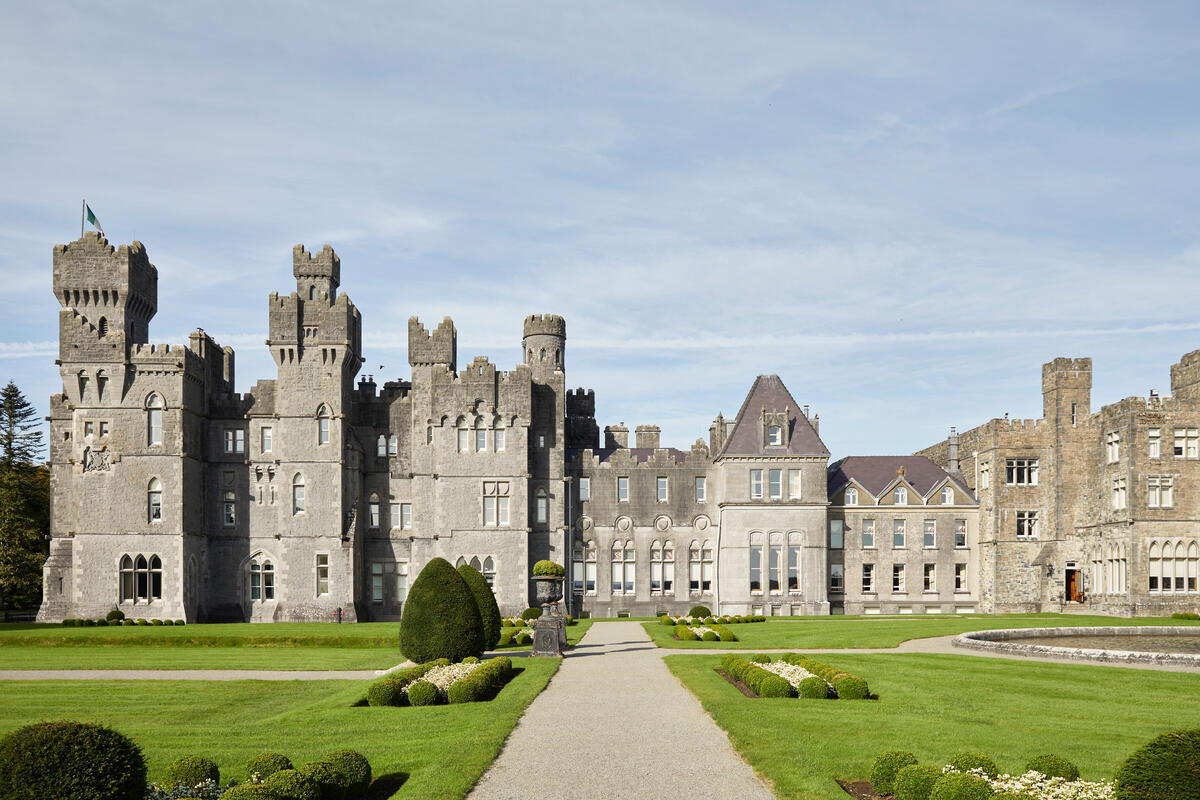
There is a particular quality to Ashford Castle that no amount of five-star designation quite captures: it is old in a way that very few places you will ever sleep in are old. The original structure was built in 1228 by the Anglo-Norman de Burgo family on the edge of an earlier monastic site near the village of Cong, where the counties of Mayo and Galway meet at the northern shore of Lough Corrib. That makes Ashford Castle nearly eight centuries old — predating the Magna Carta's first reissue, predating the Black Death, predating the entire Tudor dynasty by more than two hundred years. Walking through its corridors is, whether you think about it consciously or not, a physical encounter with the deep past of a country that has a great deal of deep past to offer.
The castle's ownership history reads like an abbreviated history of Ireland itself: the de Burgos held it for over three and a half centuries before it passed through conflict to Sir Richard Bingham, Lord President of Connaught, in 1589. The Browne family received it by Royal Grant in the 1670s, and in 1852 it was purchased by Sir Benjamin Lee Guinness — grandson of the founding Arthur — who extended the estate to 26,000 acres, planted thousands of trees and added two substantial Victorian extensions. On Sir Benjamin's death in 1868, the estate passed to his son Arthur Guinness, Lord Ardilaun, who expanded the building further in Neogothic style with architects James Franklin Fuller and George Ashlin, and oversaw the development of the massive woodland gardens that still define the estate's character today.
After Lord Ardilaun's death in 1915, the castle passed eventually to Noel Huggard, who converted it to a hotel in 1939, beginning the chapter that most visitors now inhabit: Ashford Castle as a place not merely to visit but to live in, briefly, and to experience the particular combination of history, landscape and hospitality that has made it one of the most recognised castle hotels in the world. The 2013 acquisition by the Red Carnation Hotel Collection was followed by a €47 million restoration that replaced all 820 windows, installed a new lead roof, and brought the building's infrastructure into a state of genuine luxury without disturbing the character that its centuries of history had accumulated. The hotel reopened in 2015, and the restoration has since been widely credited as one of the most thorough and sympathetic of any major Irish heritage property.
The Estate, the Rooms and the Experience
Ashford Castle sits within a 350-acre estate of formal gardens, verdant forests and ancient woodland on the shore of Lough Corrib — Ireland's second-largest lake, stretching south toward Galway City across an expanse of water dotted with more than 360 islands. The castle's 83 rooms, suites and Hideaway Cottage have been individually designed to combine original architectural features — high ceilings, stone walls, gothic windows — with contemporary luxury: bespoke beds, Egyptian cotton linen, custom-designed carpets, unique works of art and antique furniture sourced specifically for each room. No two rooms are the same in character or proportion, which gives a first visit here the quality of genuine discovery rather than the predictable uniformity of conventional luxury hotels.
The dining offer is structured around three settings of deliberately different register. The George V Dining Room, named for King George V who visited the castle in 1905, is the formal centrepiece — a grand, candlelit room with high ceilings and elaborate plasterwork where creative Irish cuisine is built around seasonal produce from the west of Ireland and ingredients foraged from the Ashford estate itself, paired with wines from an extensive cellar kept in the castle's original passageways. Cullen's at the Cottage offers a more relaxed setting in a converted estate building, with terrace dining overlooking the lake in summer. And the Connaught Room provides afternoon tea in the kind of elegantly proportioned drawing room that makes the ritual feel entirely natural rather than performative.
Activities: A Country Estate Without Equal
The activity programme at Ashford is one of the most comprehensive of any Irish hotel and draws directly on the estate's eight centuries of country house heritage. Ireland's School of Falconry, which operates on the Ashford estate, is the country's oldest falconry school, and a hawk walk with one of the resident Harris hawks through the castle grounds is consistently rated by guests as one of the most memorable experiences in the hotel's programme. Fishing on Lough Corrib, one of the most celebrated game fishing lakes in Ireland, is available for guests throughout the season, with guides and equipment provided. Horse riding, clay pigeon shooting, archery, kayaking, stand-up paddleboarding, cycling, zip-lining, golf on the estate's nine-hole course, and tennis are all available. On quieter days, the award-winning spa, a private cinema, a billiards room and a library provide indoor alternatives.
The village of Cong, a five-minute walk from the castle gates, provides a pleasant counterpoint to the estate's grandeur — a charming community of stone bridges, thatched cottages and the ruins of Cong Abbey, an Augustinian monastery founded in 1120. Cong was used extensively for filming John Ford's 1951 classic The Quiet Man, starring John Wayne and Maureen O'Hara, and the Quiet Man Museum in the village is a devoted tribute to the film's legacy. The castle's own guestbook tells a different story of famous visitors: King George V and Queen Mary, Ronald Reagan, Brad Pitt, Robin Williams, John Lennon, George Harrison, Princess Grace of Monaco and Oscar Wilde have all stayed here at various points in its history as a hotel.
The Bottom Line
Ashford Castle is not the kind of place you choose because you want a comfortable night's sleep in a good location. You choose it because you want to live, for two or three nights, inside one of the most historically significant and beautifully maintained private estates in Ireland — because you want the particular combination of great age, beautiful landscape, genuine hospitality and considered luxury that it has been refining since 1939. The splurge is real. So is the experience it delivers.