The Book of Kells: 185 Calves, Four Gospels and One Stolen Gold Cover — The Story Behind Dublin's Most Visited Object
It was written around 800 AD, stolen from a sacristy in County Meath in 1007, recovered without its cover, and has sat in Trinity College Dublin since 1661. Only two pages are visible at a time — and they change several times a year.
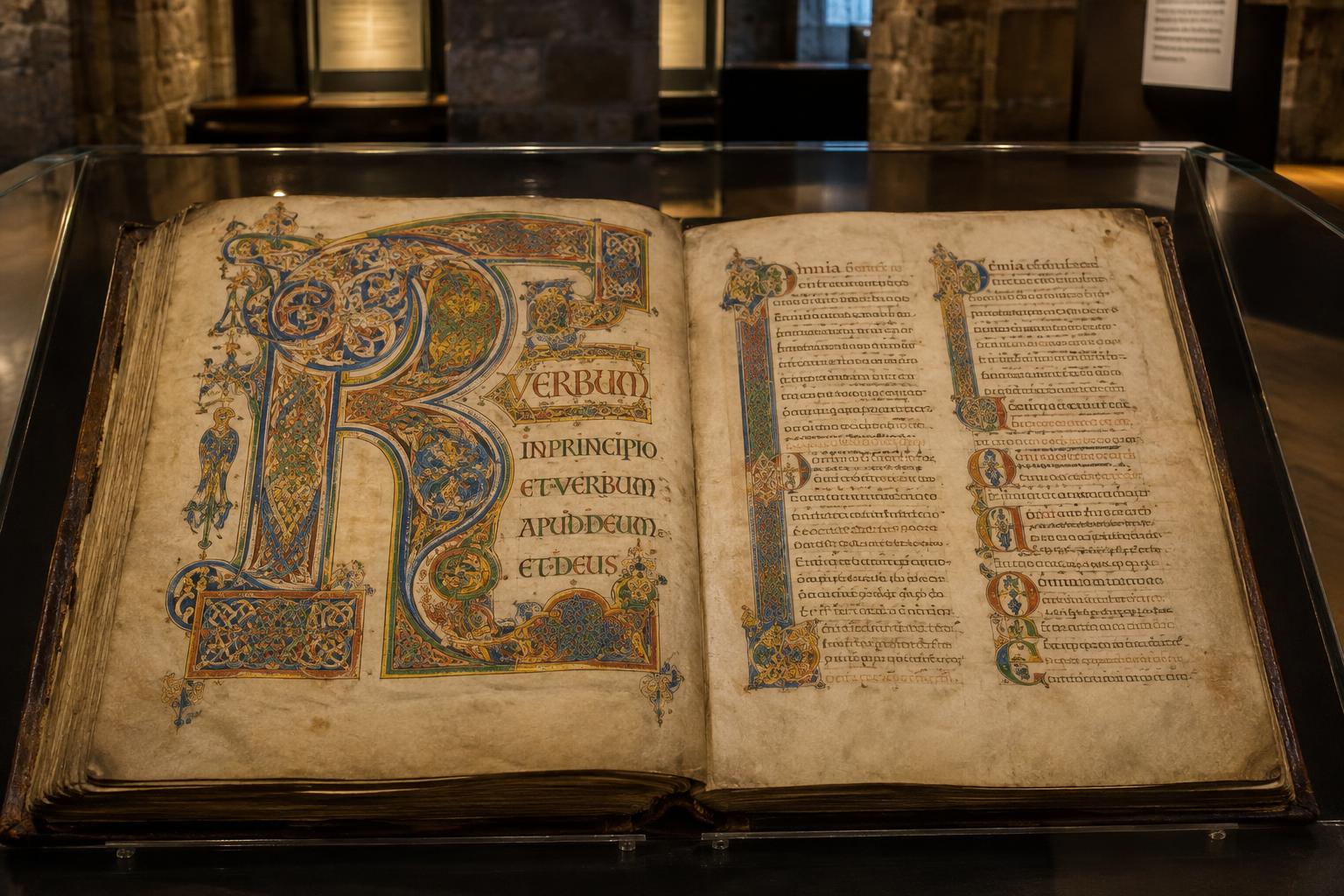
Most people come out of the Old Library at Trinity College Dublin talking about the Long Room. That is understandable — it is a 65-metre barrel-vaulted chamber lined with the library's oldest books. But the reason the queue forms is smaller than a laptop: a single manuscript, open at two pages, lying flat in a case. This piece is about that object rather than the campus around it, because the Book of Kells has a story that most visitors walk straight past on the way to the bookshop.
What you are looking at is a copy of the four Gospels in Latin, written and painted by monks of the Columban tradition around the year 800. It runs to 340 folios — roughly 680 pages — and it was never a book for reading. It was a book for display on an altar, which is why the decoration swallows the text rather than illustrating it.
Made From a Herd: Vellum, Pigment and Time
The pages are calfskin vellum, and it took the skins of an estimated 185 calves to produce the manuscript — a herd's worth of livestock committed to one book, which tells you how much the community that made it valued the project. The skins were limed, scraped, stretched and cut, then ruled with a hard point before a line of script was written.
The colours came from a mix of local and imported materials: iron gall ink for the script, and mineral and vegetable pigments for the ornament, some of them carried a very long way to reach a monastery on the western edge of Europe. The script is insular majuscule, written in a handful of distinct hands, and the ornament is the thing that makes the book famous — interlace, spirals, animal and human forms folded into initial letters, with details fine enough that they are best appreciated through the magnifiers and digital enlargements the exhibition provides.
Iona, Kells, and a Theft in 1007
The manuscript takes its name from the monastery at Kells in County Meath, but it probably did not begin there. The widely held view among scholars is that work started in the Columban monastery on Iona, off the west coast of Scotland, and that the book was brought to Kells for safekeeping after Viking raids made the island untenable in the early ninth century. The book is unfinished in places, which fits the picture of a project interrupted by upheaval.
Then, in 1007, it was stolen. The Annals of Ulster record the theft of the great gospel of Colum Cille from the stone church at Kells — described as the most precious object of the western world — and its recovery some weeks later, found buried under a sod of earth with its gold and jewelled cover torn off and gone. That cover has never been found. The thief wanted the metalwork, not the manuscript, and the accident of that preference is the reason the book survives at all.
How It Got to Trinity, and Why Only Two Pages Show
The Book of Kells came to Trinity College Dublin in 1661, in the aftermath of the Cromwellian wars, and the library has held it since. It was rebound in the twentieth century into four separate volumes, a decision made for conservation and one that also allows more than one part of the book to be shown or studied at a time.
That is why the display feels modest at first glance. Vellum and pigment degrade under light, so the book is shown open at a single opening in controlled conditions, and the pages are turned several times a year — at the time of writing the pages on view are from the Gospel of Matthew. You will not see the Chi Rho page or the carpet pages on demand. If a specific opening matters to you, every folio of the manuscript has been rescanned in high resolution and is available free in the library's digital collections, which is genuinely the better way to study the art. The case is where you go to stand in front of the actual object.
The 2026 Visit: Tickets, Timings and the Long Room
Trinity now sells the visit as the Book of Kells Experience, and there is more than one ticket, so it is worth knowing the difference before you book. The full Book of Kells Experience starts from €26 per person and covers the Old Library, the manuscript and the digital exhibition in the Red Pavilion a minute's walk away. A cheaper Book of Kells and Old Library ticket, from €19, gets you the manuscript and the Long Room but not the Red Pavilion. There is also a guided version of the Old Library tour capped at sixteen people, and Trinity Trails, the official 45-minute student-led campus walking tour, from €18, which can be bundled in front of the Book of Kells slot for a two-hour visit in total. The campus itself, including Front Square and the cobbles, is free to walk through.
Opening hours run Monday to Thursday 8.30am to 6.30pm, Friday and Saturday 8.30am to 7pm, and Sunday 9am to 6.30pm. Entry is by timed slot and Trinity recommends booking online, because there is no guarantee of a free slot if you turn up on spec — the early and late slots are consistently the quietest. A free audio guide with commentary from Trinity experts is included, and it is worth using; unguided, the manuscript case takes about four minutes, and with the audio guide it takes twenty.
Upstairs, the Long Room is going through the Old Library Redevelopment Project, a multi-year conservation programme that has involved removing and re-shelving the 200,000 oldest books in the collection. The chamber has stayed open to visitors throughout, and in the meantime it houses Gaia, a large suspended artwork of the Earth. It is a strange and effective pairing: a 1,200-year-old book downstairs, a planet hanging in the rafters above it.
The Bottom Line
The Book of Kells rewards knowing what you are looking at. Read the theft, the 185 calves and the Iona origin before you go, book a timed slot at the start or end of the day, use the free audio guide, and check which Gospel is currently open — then look up the same folio afterwards in Trinity's free digital scans, where you can enlarge the ornament far beyond what the case allows. If your budget is tight, the €19 ticket covers the manuscript and the Long Room and skips the digital pavilion. Either way, do not rush the case on your way to the bookshop. There is no second copy.