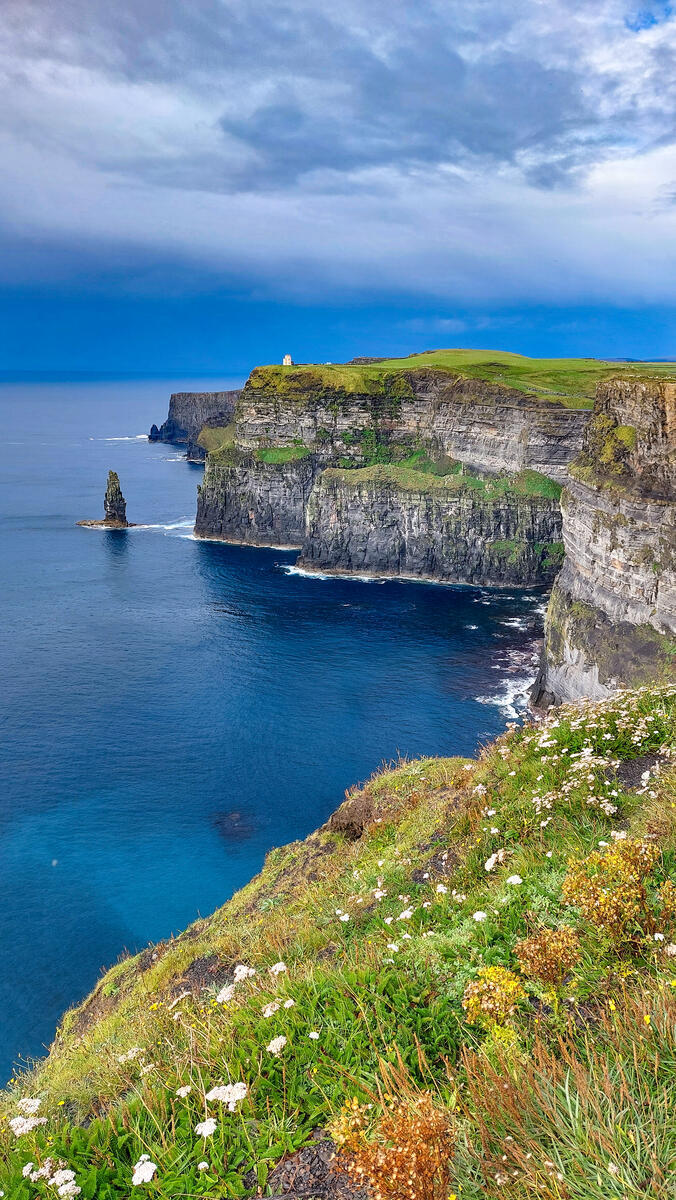
The Cliffs of Moher run for about 14 kilometres along the south-western edge of County Clare, between the village of Doolin in the north and Hag's Head in the south. The most-visited stretch — the eight kilometres centred on the Cliffs of Moher Visitor Experience at Knockardakin — reaches its maximum height of 214 metres just north of O'Brien's Tower. They are, by visitor numbers, the most-visited natural attraction in Ireland, with the operator reporting more than 1.5 million visitors a year in recent seasons.
What you are actually looking at
The cliff face is a near-vertical section through the Central Clare Group of rocks, laid down about 320 million years ago in the Upper Carboniferous period. The dark bands are shales — fine muds deposited in deep, quiet water. The paler, blockier bands are sandstones, deposited in pulses as river deltas advanced into that same sea. Today the Atlantic is cutting back into the cliff at an average of roughly 1.5 centimetres a year, undercutting the softer shale layers and leaving the harder sandstone benches to collapse in slabs. The detached sea stack visible from the main viewing area, Branaunmore, was part of the cliff itself until that process ran its course.
The whole coastline forms part of the Burren and Cliffs of Moher UNESCO Global Geopark, designated in 2011 and re-validated since, which covers most of north-west Clare.
O'Brien's Tower
The squat round tower at the highest point of the cliffs is O'Brien's Tower, built in 1835 by Sir Cornelius O'Brien, a local landowner and MP, as a viewing point for the Victorian visitors he was already trying to attract. It is open to the public for a small additional charge; on a clear day the view extends north to the Aran Islands and the mountains of Connemara, and south to Loop Head and the cliffs of north Kerry.
The birds
The cliffs are a Special Protection Area under the EU Birds Directive and one of the most important seabird breeding sites in Ireland. Around 30,000 breeding pairs use the ledges and grassy slopes each summer, including razorbills, guillemots, kittiwakes, fulmars and shags. The smaller colony of Atlantic puffins, which nest in burrows on the grassy top of Goat Island just offshore, is best seen between April and late July, usually with binoculars from the cliff path north of the visitor centre. Peregrine falcons and choughs — the red-billed, red-legged member of the crow family that is something of a west-of-Ireland speciality — are also resident.
The visitor experience
The Cliffs of Moher Visitor Experience opened in 2007. The main building is dug into the hillside behind the cliff edge — a deliberate decision to keep the skyline intact — and houses an exhibition on the geology, ecology and folklore of the cliffs, a café and shop, and the ticketing for O'Brien's Tower. Admission is by pre-booked timed ticket; walk-up entry is available when capacity allows but is not guaranteed in summer. Parking is included in the ticket. A free shuttle has operated in peak periods between the visitor centre and Doolin to reduce roadside parking on the surrounding boreens.
The Doolin Cliff Walk
The cliff-top path between Doolin and the visitor centre — about eight kilometres one way, taking most walkers between two and three hours — is the way to see the cliffs as a landscape rather than a viewpoint. The path runs on private farmland for much of its length under a long-standing local arrangement; a small voluntary contribution is collected at the Doolin end and used to maintain the route. The path is unfenced for long sections, with vertical drops a short distance from the edge, and is not suitable in high winds, poor visibility or with young children. The Hag's Head loop, south of the visitor centre, is shorter and quieter.
The cliffs on screen
Visitors regularly recognise the cliffs from film. They appear as the "Cliffs of Insanity" in The Princess Bride (1987) and as the location of the cave entrance in Harry Potter and the Half-Blood Prince (2009), among others.
Getting there and when to go
The visitor centre is on the R478, about 75 kilometres south-west of Galway city and 80 kilometres north-west of Limerick. Bus Éireann's Galway–Doolin–Cliffs of Moher service runs year-round. The cliffs face roughly west-south-west, so the light is best in the late afternoon and evening, particularly outside peak season; midsummer evenings stay bright until close to 10pm. The wind is the dominant variable — exposed Atlantic headland weather, in all senses — and a forecast that mentions gusts above 50 km/h is a forecast to reschedule.