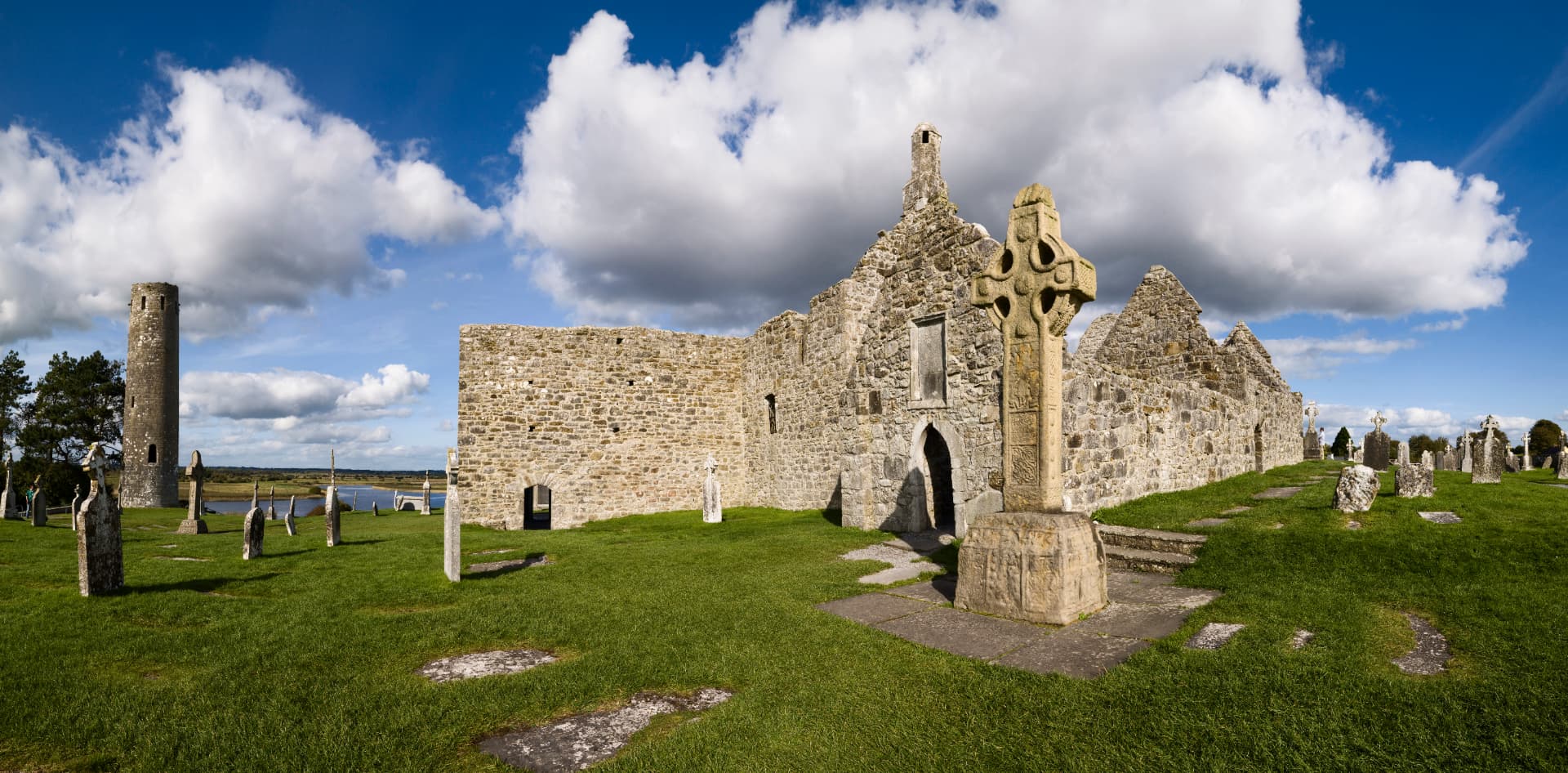
A Monastery at the Centre of the World
In the year 545 AD, a young monk from Leinster named Ciarán chose a site on the eastern bank of the River Shannon, at the point where the ancient route known as the Esker Riada crossed the river, to establish a monastery. The site was strategically chosen — the crossing point of Ireland's greatest river and its greatest overland highway made Clonmacnoise one of the most connected locations in the island — and Ciarán's foundation grew to become one of the most important centres of early medieval Christian learning in Europe. Scholars, students, craftspeople and traders arrived from across Ireland, Britain and the continent. Kings of Connacht and High Kings of Ireland were buried here. Annals recording the events of Irish history were compiled within its walls. The Clonmacnoise Crozier, one of the masterpieces of early medieval Irish metalwork, was made here.
Ciarán died of plague the same year he founded the monastery, aged 33. His site went on without him for the better part of seven centuries.
What Remains
Despite attracting visitors for almost 1,500 years, Clonmacnoise is one of the most underrated hidden gems in Ireland and makes an excellent mini-detour if driving from Dublin to Galway. What remains at the site today is, by Irish heritage standards, an extraordinary concentration of early medieval ecclesiastical architecture: the remains of a cathedral, seven churches, two round towers, three high crosses and over 600 medieval grave slabs — the largest collection of early medieval grave inscriptions in Europe. The Office of Public Works manages the site, which has a visitor centre housing the original high crosses — the Cross of the Scriptures, the North Cross and the South Cross — protected from further weathering under a climate-controlled roof, with replicas in their original outdoor positions.
The Cross of the Scriptures is the one that stops people. Standing at just over three metres high and carved from a single piece of sandstone, it is covered in interlaced panels depicting scenes from the Old and New Testament alongside decorative knotwork of extraordinary delicacy — the work of craftspeople operating at the absolute limit of what could be achieved with stone-carving tools in the early 10th century. Standing in front of it in the visitor centre, understanding that the hands that made it worked in the same century that Alfred the Great was defending England from the Vikings, produces the particular kind of temporal vertigo that the best heritage sites reliably generate.
The Shannon Setting
Clonmacnoise's setting on the Shannon floodplain adds a dimension that photographs rarely capture fully. The site sits low on the river's eastern bank, its round towers and gable ends rising above the surrounding callows — the seasonally flooded riverside meadows that have been managed for hay and grazing for centuries and that, in summer, are among the most botanically rich grassland habitats in the Irish midlands. The Shannon itself is visible from the site, broad and slow-moving, its surface reflecting the sky in a way that makes it clear why the monks who chose this location found it spiritually significant as well as strategically convenient. Evening light across the site, with the river and the callows in the middle distance and the Connacht hills beyond, is the kind of visual experience that the phrase "hidden gem" struggles to contain.
Getting There and Why It's Worth It
Clonmacnoise is approximately 16 kilometres south of Athlone on the R444, or accessible by boat from Athlone via the Shannon — the most atmospheric approach and one that replicates the experience of the medieval pilgrims and scholars who arrived by water. The site is open daily throughout the year, with seasonal variation in opening hours. Adult admission is €9, with reduced rates for children, students and seniors. Allow at least two hours for a thorough visit, and considerably more if the Shannon callows are in good condition for a walk after the heritage site.
The midlands location means Clonmacnoise sits between the major tourist flows — it is not on the way to Connemara, not on the Wild Atlantic Way, not adjacent to any of the major city-break destinations. That is precisely why it remains, for most visitors, genuinely unknown despite being one of the most historically significant places in Ireland. The drive from Dublin takes approximately 90 minutes. The drive from Galway takes approximately one hour. Either way, the detour is worth every minute.
The Bottom Line
Clonmacnoise is Ireland's most underappreciated major heritage site — a monastery founded in 545 AD that became one of early medieval Europe's great centres of learning, and that today preserves an extraordinary concentration of early Christian architecture, high crosses and grave slabs in a Shannon riverside setting of quiet, unhurried beauty. If you are driving between Dublin and Galway, take the Clonmacnoise detour. It is, without qualification, one of the most rewarding sixty-minute additions you can make to any Irish midlands journey.
Sources
- TheIrishRoadTrip.com, "27 Hidden Gems in Ireland," June 2026 — Clonmacnoise underrated, Dublin to Galway detour confirmed
- OPW.ie, Clonmacnoise Heritage Site — cathedral, seven churches, two round towers, three high crosses, 600+ grave slabs, Cross of the Scriptures, visitor centre confirmed
- DiscoverIreland.ie — site history, 545 AD founding, St Ciarán confirmed
- MyIrelandTour.com, "Hidden Gems in Ireland," February 2026 — Clonmacnoise visitor details confirmed