Few capital cities wear their history quite as openly as Dublin. The medieval street plan still runs beneath the Georgian terraces. The Liffey still divides the Northside from the Southside. And the old boundary known as The Pale — the fortified area of English control that surrounded Dublin from the late twelfth century until the Tudor reconquests — still loosely describes the commuter belt that hugs the east coast through Meath, Kildare and Wicklow.
From Longphort to Capital
Dublin's recorded history begins in 841, when a Viking longphort, or ship-fortress, was established at the confluence of the Liffey and the now-buried River Poddle. The name Dublin itself comes from the Irish Dubh Linn — the "black pool" that once formed where the two rivers met, now lying beneath the gardens of Dublin Castle. By the tenth century it was the most important Norse trading town in the Irish Sea. The Battle of Clontarf in 1014 broke Viking political power in Ireland, but the town they had built endured.
The Anglo-Norman invasion of 1169–71 transformed Dublin into the administrative capital of the Lordship of Ireland. Christ Church Cathedral, founded by the Viking king Sitric Silkenbeard around 1030 and rebuilt in stone by Strongbow after 1172, and St Patrick's Cathedral, raised to cathedral status in 1219, both survive from this period and remain working churches today.
The Pale
The term "The Pale" — from the Latin palus, meaning a stake or fence — described the area of effective English jurisdiction around Dublin. At its medieval height it stretched roughly from Dundalk in County Louth south through Meath and Dublin to the edge of County Wicklow, and inland as far as Kells and Naas. Beyond it lay the Gaelic Irish lordships, and the phrase "beyond the pale" entered the English language as shorthand for the wild country outside the line of control.
Today the Pale corresponds remarkably closely to the modern Greater Dublin commuter region. Day trips out of the city — to Newgrange and the Hill of Tara in the Boyne Valley, to the monastic ruins of Glendalough in the Wicklow Mountains, to Malahide Castle on the north coast or to the harbour towns of Howth, Dún Laoghaire and Bray — are all journeys into what was once the medieval Pale.
Trinity College
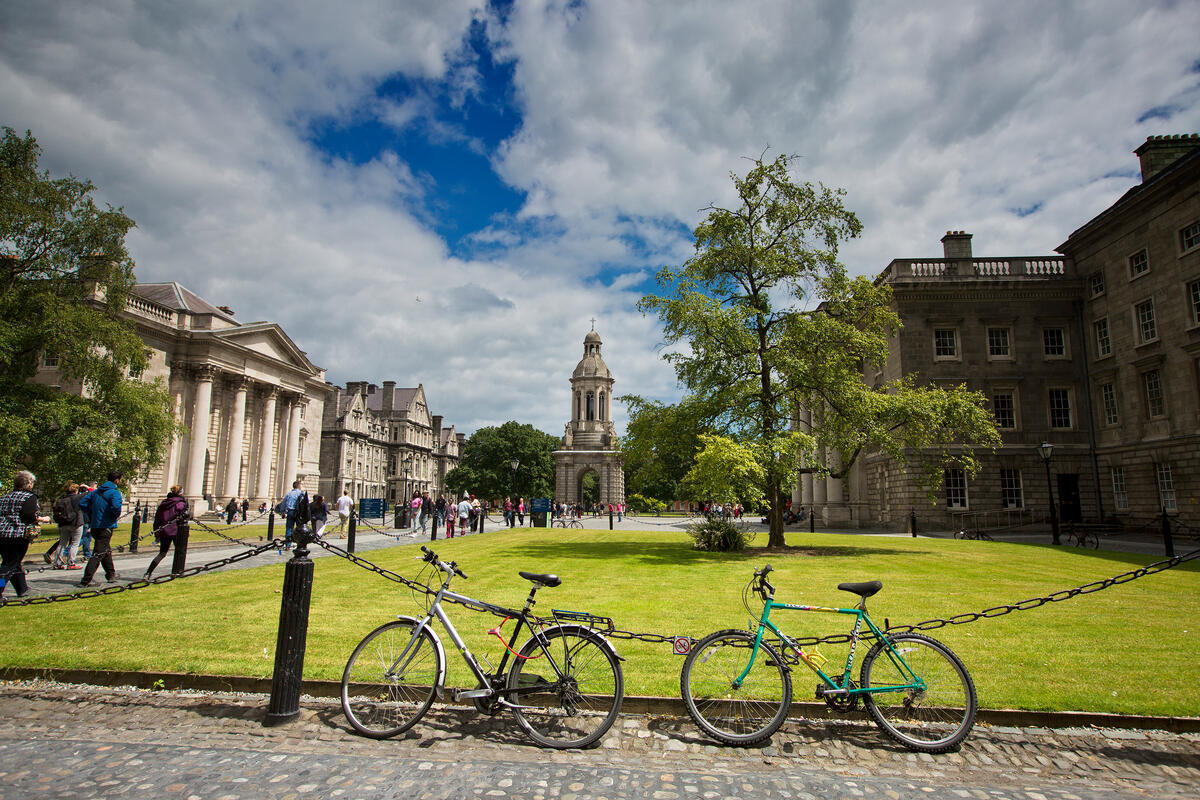
No single institution shapes the centre of Dublin quite like Trinity College. Founded in 1592 by a royal charter from Elizabeth I as "the mother of a university," it is the oldest university in Ireland and remains the country's most internationally ranked. Its forty-seven-acre campus sits squarely in the middle of the city, entered through the Regent House gate on College Green and opening into the cobbled expanse of Parliament Square, with the granite Campanile — designed by the Belfast architect Charles Lanyon and erected in 1853 — at its centre.
The college's Old Library houses the Book of Kells, the ninth-century illuminated manuscript of the four Gospels created by Columban monks around 800 AD and considered one of the great surviving works of medieval European art. Above the display gallery stretches the Long Room: a 65-metre barrel-vaulted chamber lined with 200,000 of the library's oldest books, the marble busts of philosophers and writers ranged along its length. A multi-year conservation project that began in 2023 is restoring the Long Room and re-shelving its collection; it remains open to visitors throughout the works, with timed tickets recommended in advance.
Trinity's alumni read like a syllabus of Anglo-Irish letters: Jonathan Swift, Oscar Wilde, Bram Stoker, Samuel Beckett, Edmund Burke and the mathematician William Rowan Hamilton, who scratched the formula for quaternions into the stonework of Broom Bridge on the Royal Canal in 1843 — a moment still re-enacted annually by visiting mathematicians.
Georgian Dublin
The Dublin most visitors picture — red Georgian doors, brass knockers, fanlights, leafy squares — was built in a roughly eighty-year burst between 1714 and the Act of Union in 1800, when Dublin was the second city of the British Empire and the seat of the Irish parliament on College Green. The Wide Streets Commission, established in 1757, was one of the earliest planned urban-design bodies in Europe and is responsible for the broad sweep of O'Connell Street, Westmoreland Street and D'Olier Street.
Merrion Square, Fitzwilliam Square and St Stephen's Green form the heart of the Georgian quarter on the south side. The National Gallery of Ireland, the Natural History Museum (still affectionately known as the "Dead Zoo") and Leinster House — the seat of the Oireachtas, Ireland's parliament — all front onto Merrion Square. Number 1 Merrion Square was the childhood home of Oscar Wilde, marked today by the polychrome marble Wilde statue across the road in the square's gardens.
The Coast and the Mountains
Dublin's geography is the part visitors most often underestimate. The DART suburban rail line runs the length of Dublin Bay from Howth in the north to Greystones in County Wicklow in the south, passing the working harbours of Dún Laoghaire and the Victorian seaside village of Dalkey. The Wicklow Mountains, the largest continuous upland area in the country, begin within sight of the city centre — Glendalough, the sixth-century monastic settlement founded by St Kevin, is less than an hour's drive south.
North of the city, in the Boyne Valley of County Meath, lies Brú na Bóinne: the UNESCO World Heritage complex of Neolithic passage tombs at Newgrange, Knowth and Dowth, built around 3,200 BC and older than both Stonehenge and the Egyptian pyramids. The winter-solstice alignment at Newgrange remains one of the most precise pieces of prehistoric astronomy in Europe.
Practical Notes
Dublin Airport is the main international gateway to the island, with direct flights to North America, Europe and the Middle East and the only US Customs and Border Protection preclearance facility in Europe outside of Shannon. The city centre is compact and walkable: most of the major sights — Trinity, Christ Church, Dublin Castle, the Guinness Storehouse, EPIC The Irish Emigration Museum at the Custom House Quay, and the Georgian squares — sit within a thirty-minute walk of one another.
The Pale, in the modern sense, is Dublin's day-trip hinterland. With a Leap Card, a Bus Éireann ticket or a rental car you can be standing inside the chamber at Newgrange, walking the round tower at Glendalough, or eating fish and chips on the pier at Howth within an hour of leaving College Green. That is the rare gift of this region: a working European capital with a thousand-year-old core, and a coast and countryside of genuine drama on its doorstep.