Dublin Castle: Seven Centuries of Power, a Viking Foundation, and a Castle That Became a Palace
Ordered into existence by King John in 1204 on a Viking settlement, seat of English and later British administration for seven hundred years, and handed to the Irish government in 1922. What is there now — and what is closed until January 2027.
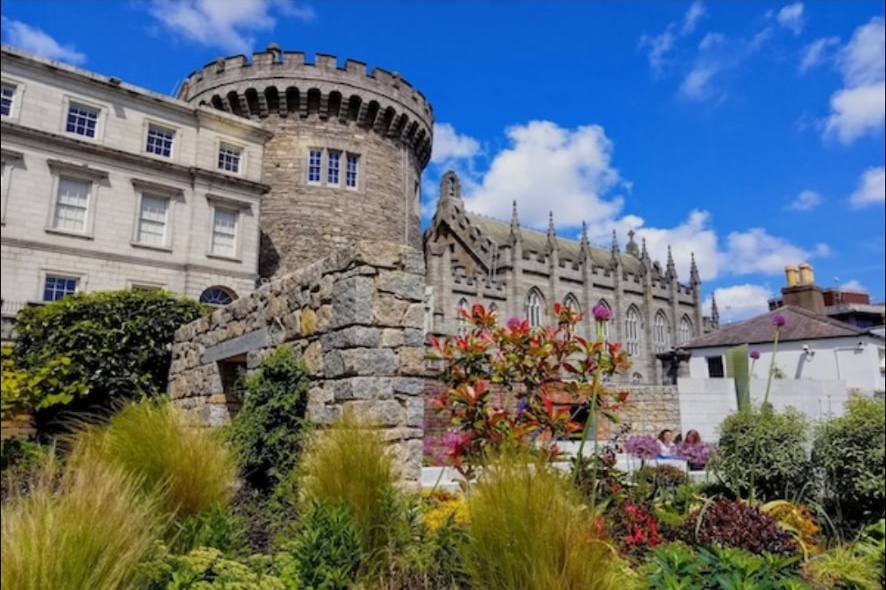
A short walk from Trinity College, on the rising ground south of the Liffey, Dublin Castle has stood at the centre of Irish power for eight hundred years. It was ordered into existence by King John of England in 1204, built on elevated ground that had been occupied by a Viking settlement since the ninth century, and from that foundation it served as the headquarters of English, and later British, administration in Ireland for the next seven centuries — right up until the handover to the new Irish government in 1922.
What you see today is not a single building but a complex: the medieval Record Tower, the Georgian State Apartments, the nineteenth-century Chapel Royal, the remains of the Viking settlement uncovered by archaeologists, and the gardens that fill the old moat. It is a working Irish government complex and a key tourist attraction in the same breath — and the layers beneath its courtyard are still being understood.
The Viking Foundation and King John's Fortress
The Dublin Vikings settled the southern bank of the Liffey around the ninth century, and the castle's elevated site was part of their trading town. When archaeological excavations began at the castle in 1961 — necessitated by building works — they uncovered well-preserved pre-castle habitation deposits from the Hiberno-Scandinavian town, the first time such deposits had been archaeologically excavated in Dublin. Further excavations between 1985 and 1987, carried out ahead of Ireland's 1990 EU Presidency building programme, revealed more of the Viking and medieval layers beneath the courtyard.
King John ordered the castle built in 1204. It was a classic medieval fortress — four corner towers linked by high curtain walls, built around a large central enclosure on the site of the present Upper Castle Yard. It served principally as the residence of the British monarch's Irish representative, the Viceroy of Ireland, and as a ceremonial and administrative centre. Over the centuries it functioned as a military fortress, a prison, a treasury, and courts of law.
The Fire of 1684 and the Georgian Transformation
In April 1684, a major fire caused severe damage to much of the medieval castle. The rebuilding campaign that followed, stretching through the late seventeenth and eighteenth centuries, transformed the site from a medieval bastion into a Georgian palace. The new building included a suite of grand reception rooms known as the State Apartments — palatial spaces that accommodated the Viceroy and were the focus of great state occasions. During the early months of each year, the Viceroy, and occasionally the visiting British monarch, hosted a series of entertainments in the State Apartments — state balls, banquets, and regal ceremonies known as "the season."
In the early nineteenth century, the castle was enhanced by the addition of the Chapel Royal, the Gothic-style chapel that still stands beside the Record Tower. The tower itself was converted in 1811 to hold state papers — expensively bound books, ancient manuscripts, and the correspondence of Viceroys and governments were stored there until 1989.
The Record Tower: The Oldest Survivor
The Record Tower — also known as the Medieval Tower, the Wardrobe Tower, or the Gunner's Tower — is the only intact portion of the medieval castle to survive the rebuilding. It dates from 1204 to 1228, largely constructed during the reign of Henry III, and its walls are up to 4.8 metres thick. In its early life it served as the king's Wardrobe Tower, storing armour, clothes, and the king's treasure. It later housed prisoners, and by the seventeenth century it had been renamed the Gunner's Tower, probably serving as the headquarters for the Master Gunner of Ireland. Its height was raised and its parapet capped with new battlements in 1811 to complement the new Chapel Royal being built next to it.
What a Visit Gets You — and What's Happening Now
Dublin Castle offers self-guided and guided tours. Self-guided tickets give access to the State Apartments at your own pace and any exhibitions running at the time. Guided tours add the Chapel Royal and the Viking Excavation — the only way to access those two areas. The average self-guided visit takes about thirty minutes; a guided tour runs about an hour.
When open, the castle is open daily, Monday to Sunday and bank holidays, from 9:45am to 5:45pm, with last admission at 5:15pm. Tours run from 10:00am to 4:30pm. It is closed 25 to 27 December and 1 January. Self-guided tickets are €8 for adults, €6 for seniors and students, €4 for children 12 to 17, free for under-12s, and €20 for a family ticket (two adults and three children). Guided tours are €12 for adults, €10 for seniors and students, €6 for children 12 to 17, free for under-12s, and €30 for a family. An OPW Heritage Card or Go City Dublin Pass covers self-guided entry only; a guided tour requires a €3 upgrade per person.
Important for 2026 visitors: the Dublin Castle campus is currently closed to the public until January 2027 to accommodate Ireland's hosting of the Presidency of the Council of the European Union. Over a hundred events — conferences, meetings, dinners, cultural events, and receptions — will take place at the castle during the six-month presidency. The campus closed on 15 June 2026, with no public access whatsoever, including no through-access from Dame Street to Ship Street. Limited access to the Chester Beatty Library, the 1926 Census Exhibition, and the Dubh Linn Gardens remains available via the Ship Street gate during this period.
As a working Irish government building, access to rooms and areas is always subject to change at short notice due to official state functions — even outside the presidency closure. There is no visitor parking on site; the nearest public car parks are Q-Park Christchurch and Park Rite Drury Street. Many bus routes stop on nearby Dame Street, Lord Edward Street, and George's Street, and the closest Luas stops are St Stephen's Green on the Green Line and Jervis on the Red Line.
The Bottom Line
Dublin Castle is the physical record of eight centuries of Irish history — Viking settlement, medieval fortress, Georgian palace, seat of empire, and handover point for a new republic, all on one small hill in the city centre. The Record Tower's four-and-a-half-metre walls have stood since the 1220s; the State Apartments hosted the balls and banquets of the Viceroy's season; the Viking layers beneath the courtyard predate the castle itself. The campus is closed for the EU Presidency through to January 2027, but the Dubh Linn Gardens and Chester Beatty Library remain reachable via Ship Street — and when the gates reopen, a guided tour is the way to see the Chapel Royal and the Viking Excavation that a self-guided ticket cannot reach.