Dún Aonghasa: A 3,000-Year-Old Stone Fort on a 100-Metre Cliff, and the Most Extraordinary View in Ireland
First enclosed around 1100 BC on the south coast of Inis Mór, refortified in the early medieval period, and perched on a sheer cliff above the Atlantic with no safety barrier at the edge — the largest of the Aran Islands' seven prehistoric stone forts reopened with a new €1.6 million visitor centre in 2026.
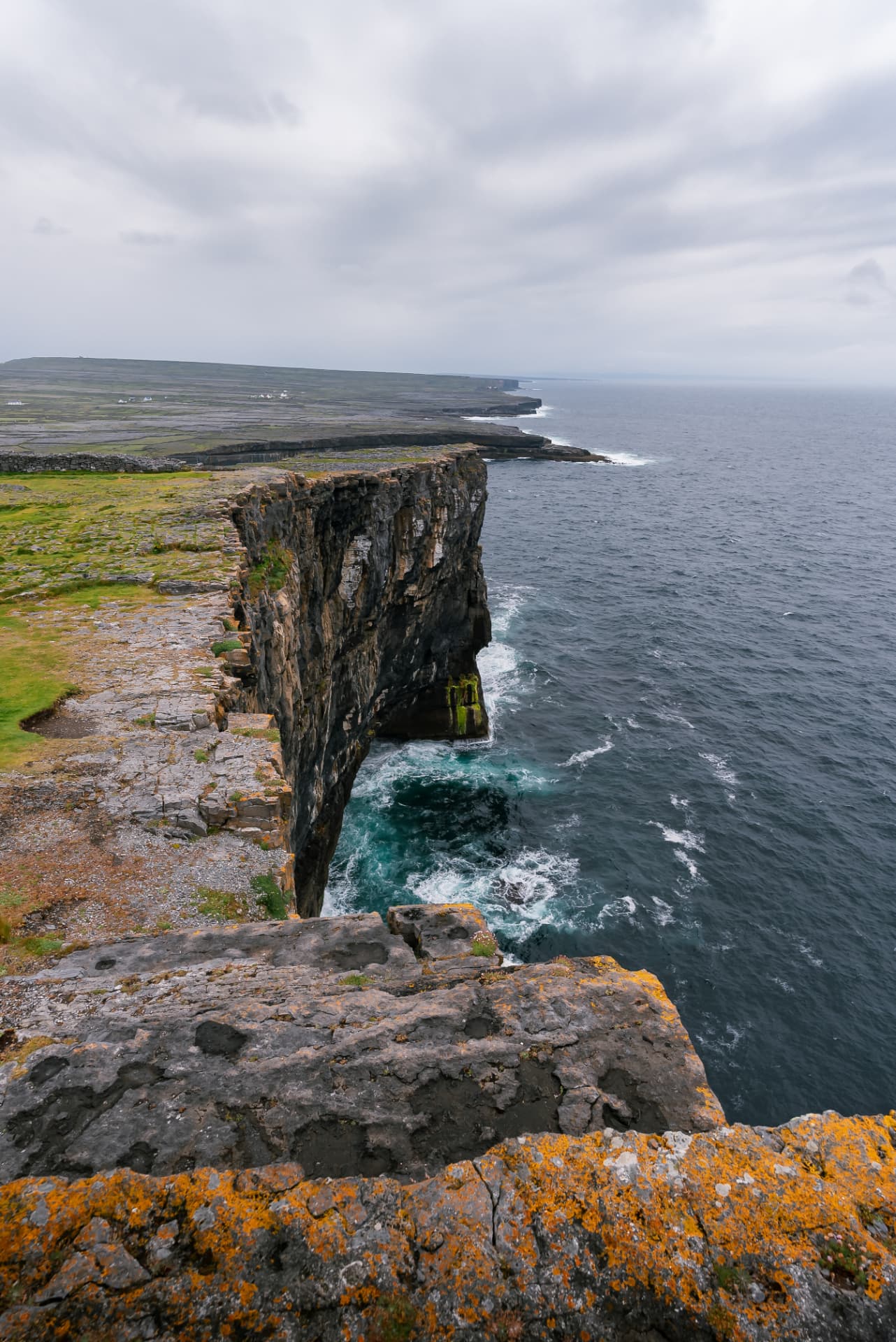
There is a moment, walking up the last stretch of limestone pavement towards Dún Aonghasa, when the ground simply stops. One step more and there is nothing — a hundred metres of vertical air and then the Atlantic, exploding white against the base of the cliff. There is no fence. There is no railing. There is a low stone wall, three thousand years old, running right to the edge and then ending, as if the people who built it ran out of cliff.
This is the experience that brings people to Inis Mór, the largest of the three Aran Islands in Galway Bay, and it is unlike anything else at a heritage site in Ireland. Dún Aonghasa — the Fort of Aonghasa — is a prehistoric stone hillfort built in concentric drystone walls on a narrow limestone plateau above the sea, first enclosed around 1100 BC and rebuilt more than once across the three millennia since. It is the largest and best known of seven prehistoric stone forts on the Aran Islands, a National Monument protected since the late nineteenth century, and in May 2026 it reopened with a new €1.6 million visitor centre and immersive exhibition funded by the Office of Public Works, Fáilte Ireland and the Department of Housing, Local Government and Heritage.
Built in 1100 BC, Rebuilt Twice Over
Archaeological excavation by the Discovery Programme in the 1990s established that the first enclosure was built around 1100 BC, during the Late Bronze Age, when rubble was piled against large upright stones to form the initial ring. Around 500 BC, in the Iron Age, a triple-wall defensive system was built along the fort's western side, the walls thickened and raised — the inner wall alone is estimated to have taken roughly 1,270 cubic tons of stone to build, and stands up to four metres wide and six metres high in places. The whole complex was refortified again in the early medieval period, between 700 and 800 AD, before being abandoned shortly afterwards.
The excavations turned up evidence of continuous human activity on the hilltop stretching from around 1500 BC to 1000 AD — bronze casting moulds dated to around 900 BC, the remains of houses, and burials. Late Bronze Age objects including rings, tools, beads and foodstuffs were found on the site and are now held in the National Museum of Ireland in Dublin. The fort covers about 5.7 hectares — fourteen acres — divided into an outer, middle and inner enclosure by three curvilinear drystone walls that terminate at the cliff.
The Chevaux-de-Frise: A Forest of Standing Stones
Outside the middle wall runs the fort's most striking defensive feature: a chevaux-de-frise, a broad band of thousands of jagged limestone slabs set upright into the ground, running from cliff edge to cliff edge. Added around 700 BC, it was designed to slow and break up any approach on foot or on horseback — and even today, walking through it, the stones are difficult to negotiate. A similar defensive system survives at Ballykinvarga in County Clare, but nothing else in Ireland survives on this scale.
At the cliff edge itself, inside the inner enclosure, sits a large rectangular stone slab whose function is still unknown. Some archaeologists suggest it had a ritual significance, marking the most dramatic point of the fort above the sea. The sea, too, has changed: at the time of construction sea levels were considerably lower, and a recent RTÉ documentary estimated that the fort originally stood about a thousand metres from the water. Marine erosion has since eaten into the cliff, and parts of the fort are thought to have collapsed into the Atlantic.
Who Was Aonghasa?
Nobody knows. The name means "Fort of Aonghasa," and the identity of Aonghasa is one of the open questions of Irish prehistory. Candidates proposed over the years include the pre-Christian god Aonghus described in Irish mythology; the mythical king Aonghus mac Úmhór, traditionally associated with the Fir Bolg; and Aonghus Mac Natfraich, a 5th-century King of Cashel who had dynastic connections with Aran. The 19th-century antiquarian and artist George Petrie called Dún Aonghasa "the most magnificent barbaric monument in Europe" — and that description, at least, has held up.
What the fort was for is also debated: a royal residence, a refuge, a ritual centre, or a lookout post commanding the Atlantic approaches to Galway Bay. What is certain is the view. From the ramparts the sightlines run unbroken across Galway Bay to the Connemara mountains, take in the neighbouring Aran Islands of Inis Meáin and Inis Oírr, and on exceptionally clear days reach the Cliffs of Moher on the Clare mainland, roughly 75 miles away.
The 2026 Visitor Centre and How to Actually Do It
The new visitor centre sits at Cill Mhuirbhigh — Kilmurvey — on the edge of a craft village, at the start of a one-kilometre pedestrian route to the fort over rough limestone ground. The walk takes fifteen to twenty-five minutes and is the approach that gives nothing away until the very last moment, when the cliff edge and the full weight of what you are standing on becomes apparent. The centre houses the new immersive exhibition, and guided tours are available. Drones are not permitted, for the safety and comfort of visitors and staff.
Dún Aonghasa is open year-round. Opening hours are January to March 9:30am to 4pm, April to October 9:30am to 6pm, and November to December 9:30am to 4pm, closed 24 to 30 December. Admission is €5 for adults, €4 for groups and seniors, €3 for children and students, and €13 for a family — and admission is free if you are staying overnight on Inis Mór in participating accommodation. The visitor centre can be contacted on 099 61008.
Most people cycle to the fort from Kilronan, the island's main village and ferry pier, along roads that thread between dry stone walls and limestone pavement — the cycle itself has become an attraction. Ferries to Inis Mór depart from Rossaveel, about 40 kilometres west of Galway city, with a crossing of roughly 40 minutes, and Aer Árann Islands operates a seven-minute flight from Connemara Airport. May, June and September offer the best balance of weather and manageable crowds; July and August are the busiest. Allow a full day for the island, and do not rush the walk up to the fort — the approach across the karst is half of the experience.
The Bottom Line
Dún Aonghasa is the single most dramatic prehistoric site you can stand on in Ireland — a three-thousand-year-old stone fort built to the very edge of a hundred-metre cliff above the open Atlantic, with no barrier between you and the drop. Pay €5 at the new 2026 visitor centre, walk the kilometre over the limestone, go through the chevaux-de-frise, and stand at the cliff wall. The view alone is worth the ferry; the knowledge that people built this here, in 1100 BC, and that the stone they laid is still holding, is what makes it stay with you. Go in May or September, stay overnight on Inis Mór and admission is free, and do not bring a drone. The Banshees of Inisherin put these islands on the cinematic map — Dún Aonghasa is the reason they were here in the first place.