Glendalough: A 6th-Century Monastic City in a Wicklow Valley, Where a 30-Metre Round Tower Still Stands Above the Graves
St Kevin founded a monastery here around 570 AD, lived as a hermit in a clifftop cave, and built one of early Christian Ireland's great centres of learning. The round tower, the cathedral, the stone churches and the two lakes are all free to walk into, an hour south of Dublin.
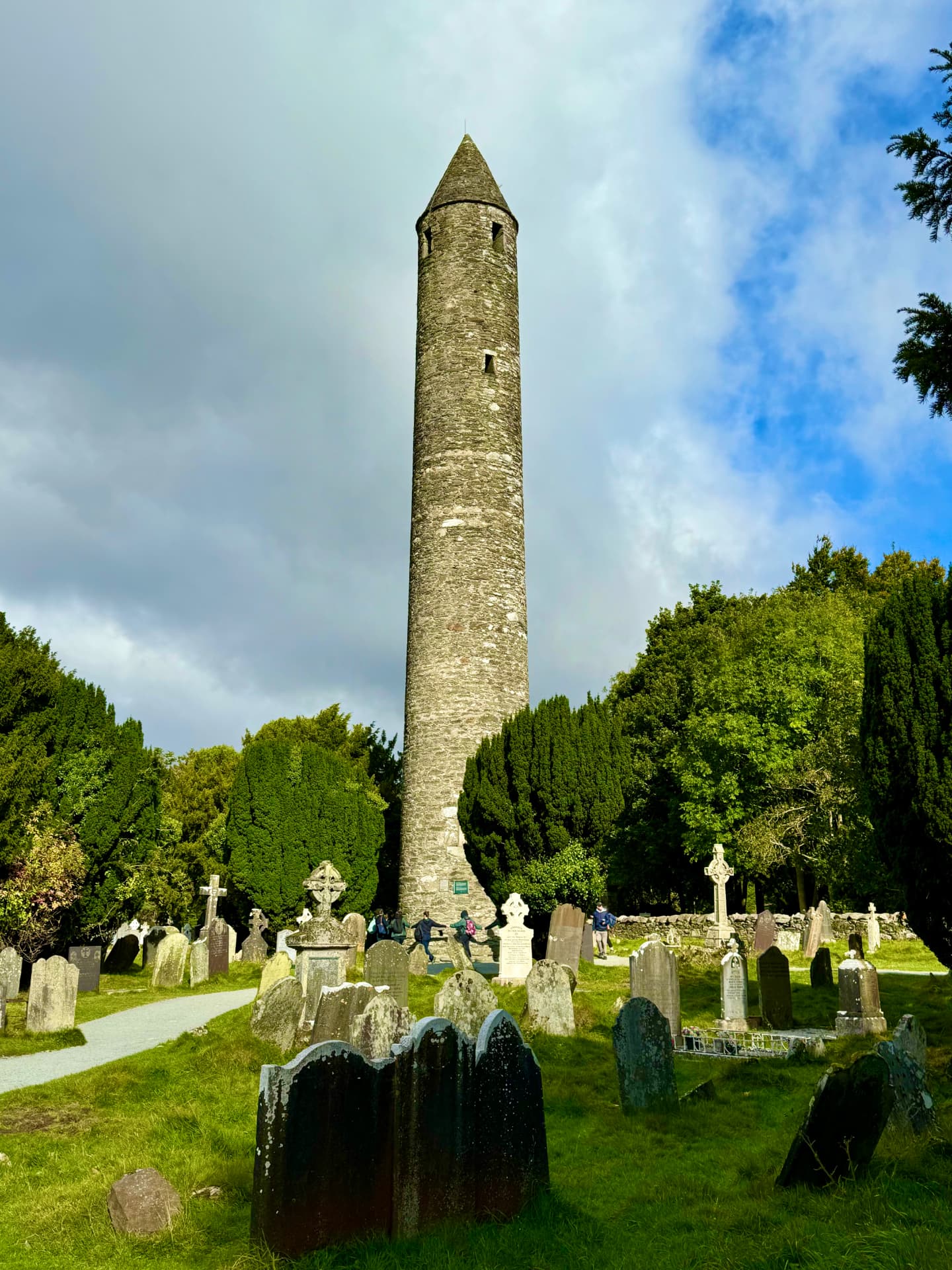
There is a single image that almost everyone who has been to Glendalough carries away: a slender stone round tower, about 30 metres high, rising out of a graveyard in a Wicklow mountain valley. It is the picture on the postcards, and it is also the thing you actually see when you walk in — because the monastic site is free, open around the clock, and sits less than an hour south of Dublin. What the postcard does not tell you is that the tower is one piece of a 6th-century monastic city spread across a glacial valley between two lakes, founded by a hermit saint who first lived in a cave in the cliff above the water.
Glendalough — Gleann Dá Loch, the valley of two lakes — is a glacial valley in the Wicklow Mountains, and it holds one of the most important early Christian monastic sites in Ireland. It sits inside Wicklow Mountains National Park, the largest of Ireland's national parks at almost 23,000 hectares and the only one on the east coast. The monastic site itself is free to enter and accessible all year round, day and night; the only charges are for the car parks and the Visitor Centre.
St Kevin, the Hermit in the Cliff
Kevin — Cóemgen in Irish — was a descendant of one of the ruling families of Leinster who came to the valley in the 6th century to live as a hermit. According to tradition he spent his first seven years at Glendalough alone, in a tiny artificial cave carved into the cliff face above the Upper Lake and now known as St Kevin's Bed, before founding a monastery where two rivers meet lower down the valley. He died around 618 AD, traditionally on 3 June, and for the next six centuries Glendalough flourished as one of the great centres of learning and pilgrimage in early Christian Ireland.
The stories that came down about Kevin stress his solitude and his love of the animals and plants of the valley — one legend has him refusing an angel's offer to flatten the mountains into farmland, out of concern for the wildlife that lived there. Whatever the truth of the legends, the archaeology confirms the early date: recent excavations near the Upper Lake have produced radiocarbon dates overlapping St Kevin's own lifetime, and a ditch up to eight metres wide has been found between the main monastic complex and St Mary's Church at the Lower Lake.
The Round Tower, the Gateway and the Stone Churches
The surviving monuments are scattered across the valley. The round tower, the best-known, stands about 30 metres high with a conical cap and narrow windows high up the shaft — built as a bell tower and a place of refuge, and still intact after roughly a thousand years. Near it is the Cathedral, the largest church on the site, and the Priest's House, a small stone oratory. St Kevin's Church, with its steep stone roof and distinctive round belfry, is the most recognisable building after the tower. Across the river stands St Mary's Church, one of the earliest churches on the site, now partially restored. The entrance to the monastic city is through a carved stone gateway, one of only two surviving early medieval stone gateways in Ireland, with a rounded Romanesque arch.
Further up the valley, at the Upper Lake, are the quieter and older remains. Reefert Church sits in a clearing above the water; Templenaskellig, the church of the skelligs, is built on a ledge above the lake and was used by later hermits imitating Kevin's solitary life. St Kevin's Bed is the cave in the cliff above the lake — reputedly hand-carved by Kevin, though archaeologists note it may in fact be a prehistoric burial place that far predates him. A series of stone crosses marks the pilgrim route between the lower and upper sites.
Vikings, Normans and a Lead Mine
Glendalough was never left in peace for long. The Irish Annals record raids on the settlement by Vikings and by local warring kings over the centuries; in 1398 the diocese of Glendalough was formally disestablished and absorbed into Dublin. After the medieval period the valley took on a second, industrial life: from 1825 to 1957 the head of the Glendalough Valley was the site of a galena lead mine, and the remains of the mine workings and the miners' village are still visible on the walk up to the Upper Lake. The mine closed in 1957, and the valley has been a protected National Park since 1991.
In 2024 Powerscourt and Avondale topped the Wicklow visitor-attraction lists, but Glendalough remains one of the most visited heritage sites in the country, drawing well over 700,000 visitors a year at its peak. Fáilte Ireland has since published a Visitor Experience and Management Masterplan for Glendalough and the Wicklow Mountains National Park, aimed at managing the flow of visitors through the valley and protecting the landscape and habitats that make it worth visiting in the first place.
Two Lakes, Walking Trails and How to Actually Do It
The two lakes — the Lower Lake, beside the monastic site, and the Upper Lake, higher up the valley — are connected by a flat, easy walking path through oak woodland called the Green Road, about 3km each way. The Green Road is the walk most people do, and it is the one that takes you from the round tower to the quieter upper valley where the hermit sites are. Beyond it, a network of nine maintained trails of varying difficulty climbs the surrounding mountains — the Derrybawn Woodland Trail, the Spinc and the Wicklow Way all start or pass through the valley, and the Spinc ridge walk gives the best high view down over both lakes.
The Visitor Centre is run by the Office of Public Works and is the place to start if you want context. It is open all year, closed only 23 to 29 December, with mid-March to 14 October hours of 9.30am to 6pm (last admission 5.15pm) and 15 October to mid-March hours of 9.30am to 5pm (last admission 4.15pm). Adult admission is €5, group or senior €4, child or student €3, family €13 — and if you pay for parking in the Visitor Centre car park you are entitled to one free admission to the centre. Tours of the monastic site can be booked through the Visitor Centre on 0404 45325. The monastic site and the lakes themselves cost nothing and are open around the clock.
Parking is the one thing to get right. There are two car parks — the Lower Lake car park near the Visitor Centre and the Upper Lake car park higher up the valley — and both fill early in summer. Arrive before 9.30am or after 3pm to avoid the tour-bus peak. St Kevin's Bus runs direct from Dublin city centre. Dogs are welcome but must stay on leads at all times — the valley is a wildlife conservation area. There are toilets at the Visitor Centre and at the Upper Lake car park, though the Upper Lake toilets may close early in winter. Allow two to three hours for the monastic site and the lakeside walk, and a half-day if you add a mountain trail.
The Bottom Line
Glendalough is the easiest big historical day out from Dublin: an hour south, free to walk into, and with a round tower, a 6th-century monastic city, a hermit's clifftop cave and two mountain lakes all in the one valley. Pay €5 for the Visitor Centre if you want the story, pay €4 to park, and walk the Green Road from the lower site to the Upper Lake — that single path takes you from the busy round tower to the quietest part of the valley and is the walk that makes the place. Go early or go late, keep your dog on a lead, and do not just photograph the tower and leave. The upper valley is where Glendalough becomes the place St Kevin came to find.