Slieve League Cliffs, County Donegal: Higher Than the Cliffs of Moher, and a Fraction of the Crowds
At 601 metres, the sea cliffs of south-west Donegal rise far above the Cliffs of Moher — and they still draw a fraction of the crowds.
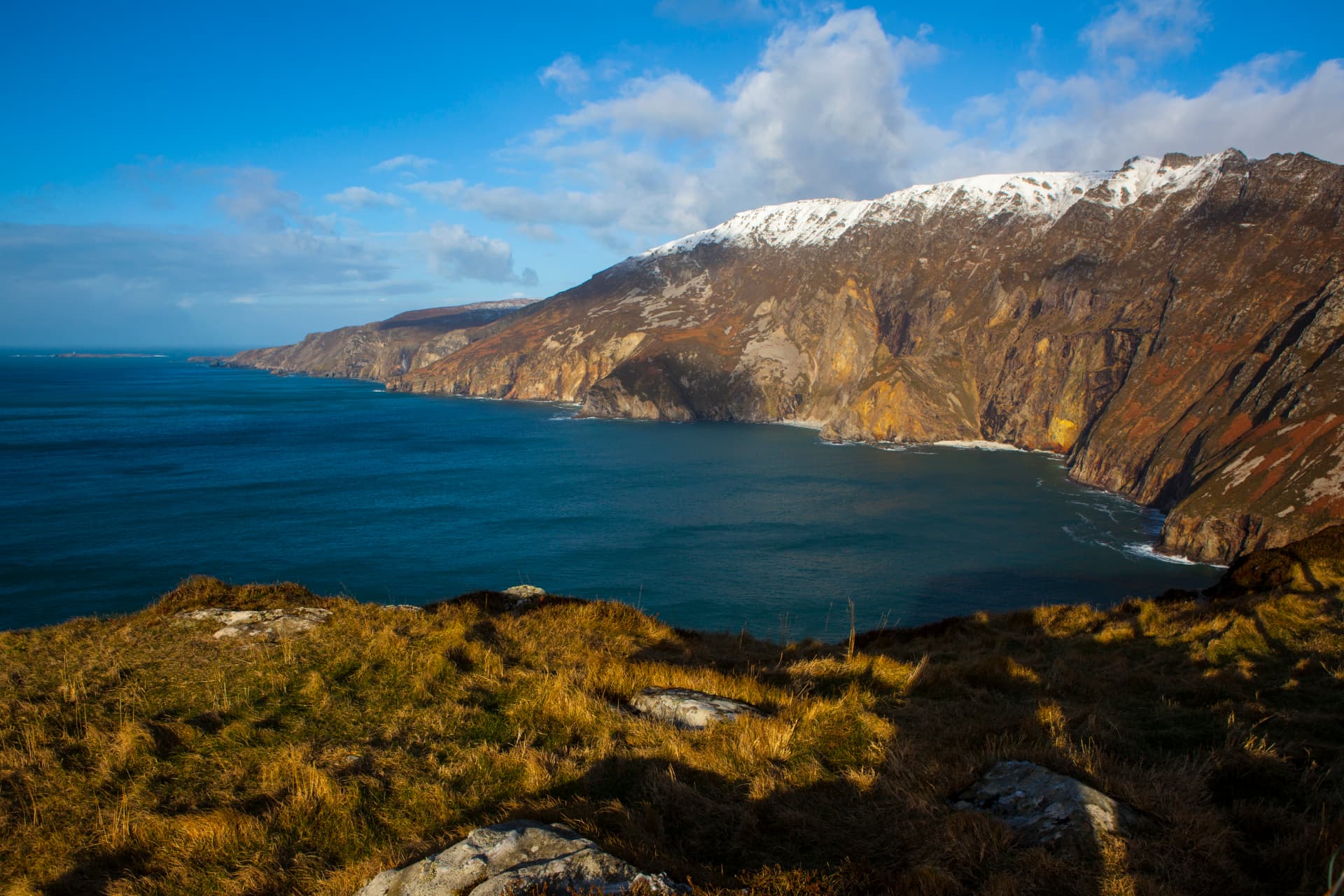
The Numbers That Should Make This Famous
The Slieve League cliffs on the south-west coast of County Donegal rise to 601 metres above sea level at their highest point — making them among the highest sea cliffs in Europe, and significantly higher than the Cliffs of Moher in County Clare, which reach a maximum of 214 metres and attract approximately 1.5 million visitors per year. The Slieve League cliffs attract a fraction of that number. The arithmetic does not add up in any conventional tourism logic, and the gap it describes is one of the most straightforward pieces of evidence in Irish tourism that outstanding natural scenery and visitor numbers are not the same thing.
The cliffs are located near the village of Teelin in the Gaeltacht area of south-west Donegal, accessible from Carrick on the R263. They face south-west into the full Atlantic, which means that the waves that have carved them over millions of years still arrive with the full force of the open ocean, and the views from the cliff edge on a clear day extend south to Sligo, north to the Donegal mountains and west to the ocean horizon. On days when the Atlantic is in any kind of mood, the spectacle of waves breaking against 600-metre walls of quartzite and sandstone produces a sound and a spray that can be felt hundreds of metres from the cliff edge.
The Access Options
There are two main ways to experience the Slieve League cliffs. The shorter approach — a well-surfaced road to the Bunglass viewpoint, where a car park provides direct access to a cliff-edge viewing area — takes approximately ten minutes from Teelin and gives views of the cliff face from its full height without requiring any significant physical effort. It is also, in the right conditions, one of the most spectacular viewpoints in Ireland — the cliff falling away directly below the viewing area, the Atlantic stretching to the horizon, the colours of the quartzite and sandstone changing with the light through the day.
The longer approach — the One Man's Pass walk, which traverses the cliff-top ridge from the Bunglass car park to the summit of Slieve League and back — is one of the more dramatic coastal walks in Ireland and one that requires a head for heights, appropriate footwear and good conditions to be safely attempted. One Man's Pass itself — a section of the ridge where the path narrows to a few feet with drops on both sides — is the section that gives the walk its reputation, though experienced hillwalkers find it manageable given care and clear weather. The views from the summit ridge, across the entire south-west coast of Donegal, are the reward for the additional effort.
The Village of Teelin and the Surrounding Area
Teelin is a small Gaeltacht village — Irish is spoken here as the daily community language — at the head of a sheltered bay, with a traditional boat building heritage and a pub, Rusty Mackerel, that has hosted impromptu traditional music sessions since at least the 1960s. The session culture of Teelin is not manufactured for tourism — it emerges from the same musical tradition that produced the fiddle players, uilleann pipers and singers of south Donegal, and arriving at the Rusty Mackerel on the right evening to find a session in progress is one of those Irish pub experiences that cannot be booked or guaranteed but that, when it happens, is entirely self-explanatory.
The coastline around Teelin and south-west Donegal is part of the Wild Atlantic Way and offers additional walking routes, coastal scenery and the small harbours and fishing communities of the Kilcar and Killybegs area — the latter being the largest fishing port in Ireland, where the trawler fleet that supplies much of Ireland's fresh fish lands its catch.
Why It Remains Relatively Unknown
The primary reason the Slieve League cliffs remain less visited than the Cliffs of Moher — beyond the simpler geographical fact that Donegal is further from Dublin and Cork than Clare — is infrastructure. The road to Teelin is adequate but narrow, accommodation in the immediate area is limited compared to the Burren and Clare coast, and the broader Donegal tourism offering, while genuinely outstanding, has been less intensively promoted than the Wild Atlantic Way's southern reaches. That is changing: investment in infrastructure, signage and visitor facilities around Slieve League has increased in recent years, and the cliffs appear more frequently in Irish tourism promotion than they did five years ago.
The consequence of that change is that the window of genuinely low visitor numbers at Slieve League may be shorter than it was. Going now — in September, when summer crowds have reduced, the autumn light on the cliffs is at its most dramatic and the walking conditions on the ridge path are often excellent — is the right time.
The Bottom Line
The Slieve League cliffs are, by the most straightforward measure — height — among the most dramatic sea cliffs in Europe, and they receive a fraction of the visitor numbers of a considerably smaller and less remote set of cliffs in Clare. The gap is partly geographical and partly promotional, and it is narrowing as awareness of Slieve League grows. Going now, in September, before the final narrowing of that gap occurs, means finding 601 metres of Atlantic cliff face in conditions of relative solitude that will not be available indefinitely. The sheep on the path to the summit will not be impressed by your presence. The view will be.