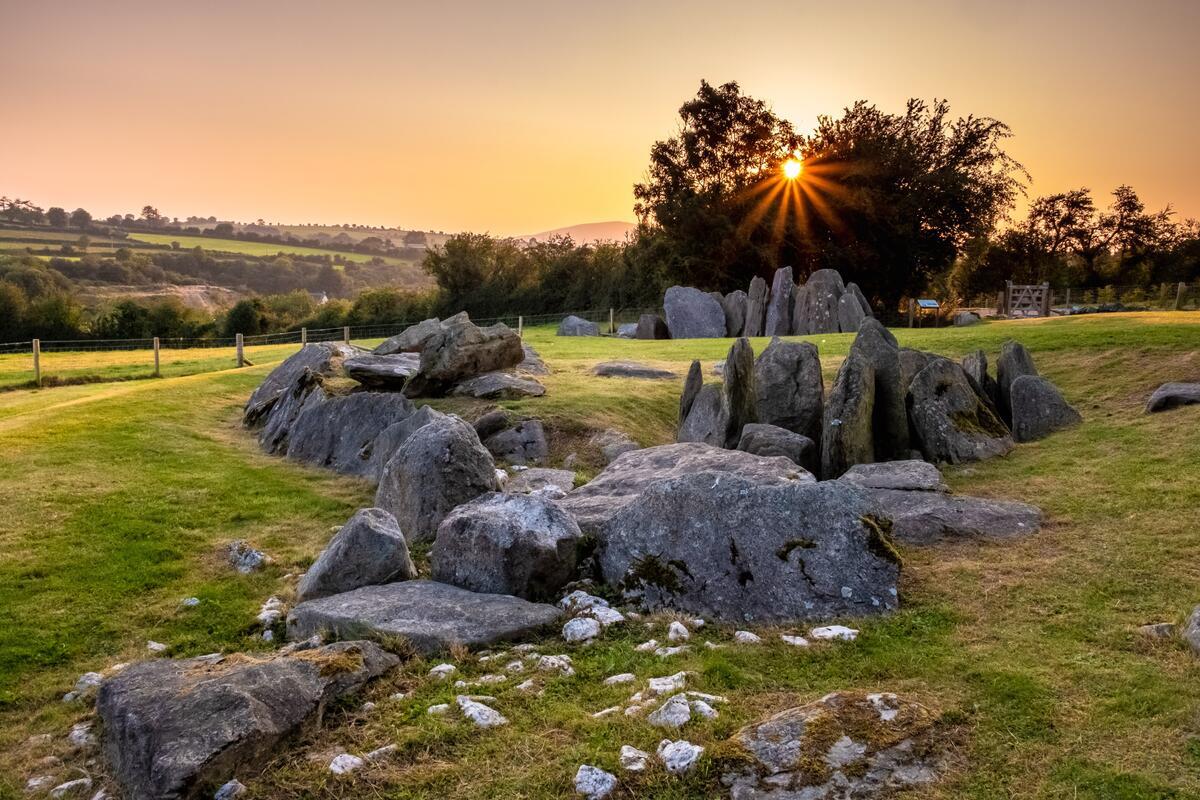
For most of the modern history of Irish tourism, the middle of the country was the part the marketing brochures left out. The Wild Atlantic Way had its cliffs. Ireland's Ancient East had its castles. Dublin had everything else. The counties in between — Longford, Roscommon, Leitrim, the inland reaches of Cavan and the north of Tipperary — were where you drove through on the way to somewhere photogenic.
That began to change in 2018, when Fáilte Ireland launched Ireland's Hidden Heartlands as the country's fourth official tourism brand, alongside the Wild Atlantic Way, Ireland's Ancient East and Dublin. The proposition was deliberately understated: a region defined by inland waterways, blanket bog, lakes and a slower pace, rather than by a coastline or a capital city.
Eight years on, the Hidden Heartlands has grown into something more substantial than a marketing concept. It is the part of Ireland that visitors who already know the country come back for.
What and Where It Is
The Hidden Heartlands is anchored on the River Shannon — the longest river in either Ireland or Britain at 360 kilometres — and the chain of lakes it flows through, including Lough Ree, Lough Derg and Lough Allen. The region covers parts of counties Leitrim, Longford, Roscommon, north Tipperary, east Galway, Cavan, Westmeath and Offaly.
It does not have a single signature attraction in the way that the Wild Atlantic Way has the Cliffs of Moher. What it has instead is a network: of waterways, of greenways, of small market towns, of working bogs being rewetted as carbon sinks and of heritage sites that have been quietly looked after for thousands of years.
The Greenways
The most visible recent change in the region has been the construction of long-distance walking and cycling routes built along former railway lines and canal towpaths.
The Old Rail Trail, part of the wider Mullingar–Athlone greenway, runs for 42 kilometres on the bed of the old Midland Great Western Railway between Mullingar in Westmeath and Athlone on the Shannon. It is entirely off-road and almost entirely flat — accessible to families, casual cyclists and visitors who have never sat on a bicycle in Ireland in their lives.
The Royal Canal Greenway, opened in 2021, runs for 130 kilometres from Maynooth in County Kildare to Cloondara in County Longford, where it meets the Shannon. It is the longest off-road greenway in Ireland. The towpath was used for centuries by horses pulling barges of grain, turf and porter between Dublin and the western interior; it now carries walkers, cyclists and the occasional curious heron.
The Beara-Breifne Way, a long-distance walking route loosely following the line of Donal Cam O'Sullivan Beare's march of 1602 from west Cork to Leitrim, threads through the region from south to north.
The Shannon
The Shannon is the spine of the region and the reason much of it exists in the form it does. The river is navigable for the great majority of its length, and a long-established cruiser hire industry — based at marinas in Carrick-on-Shannon, Athlone, Banagher and Portumna — puts the entire system within reach of visitors who have never piloted a boat before.
Carrick-on-Shannon in County Leitrim is the busiest cruising town on the river. Lough Key, just to the south of Boyle in County Roscommon, has a forest park with a treetop walkway, a zip line and the ruins of Rockingham House on an island in the lake. Clonmacnoise, on a bend of the Shannon in County Offaly, is one of the most important early Christian monastic sites in Europe — founded by Saint Ciarán in 544 AD and continuously occupied as a centre of learning for almost a thousand years.
The Bog
The midlands of Ireland sit on one of the largest expanses of raised bog and blanket bog in Europe. For most of the twentieth century these bogs were stripped by Bord na Móna for peat fuel. That extraction has now ended — Bord na Móna's last peat-fired electricity station closed in 2020 — and the company is now in the middle of the largest peatland restoration project in the history of the state, rewetting 33,000 hectares of cutaway bog as a carbon sink and a wildlife habitat.
The visitor side of this story is the Bord na Móna Lough Boora Discovery Park in County Offaly, where former industrial cutaway has been redeveloped into a 2,000-hectare park of walking trails, large-scale outdoor sculpture and restored wetland that draws wading birds, hares and the occasional otter.
Practical Notes
Athlone, more or less in the geographic centre of the country, is the obvious base. Sean's Bar in the town claims a foundation date of 900 AD and is listed by Guinness World Records as the oldest pub in Ireland. From Athlone the Shannon, Clonmacnoise, Lough Ree, the Old Rail Trail and the Royal Canal Greenway are all within a short drive.
Carrick-on-Shannon is the natural base for the upper Shannon, Lough Key and the Leitrim hill country. Birr in County Offaly — home of the Birr Castle demesne and the historic Leviathan telescope, built in 1845 and at the time the largest in the world — is the southern gateway.
None of this is going to make the same Instagram impression as a Cliffs of Moher sunset. That, in the end, is the point. The Hidden Heartlands is the part of Ireland for the second or third visit — quieter, slower and considerably less crowded than the coast. Once you have been, it tends to become the part you come back to.