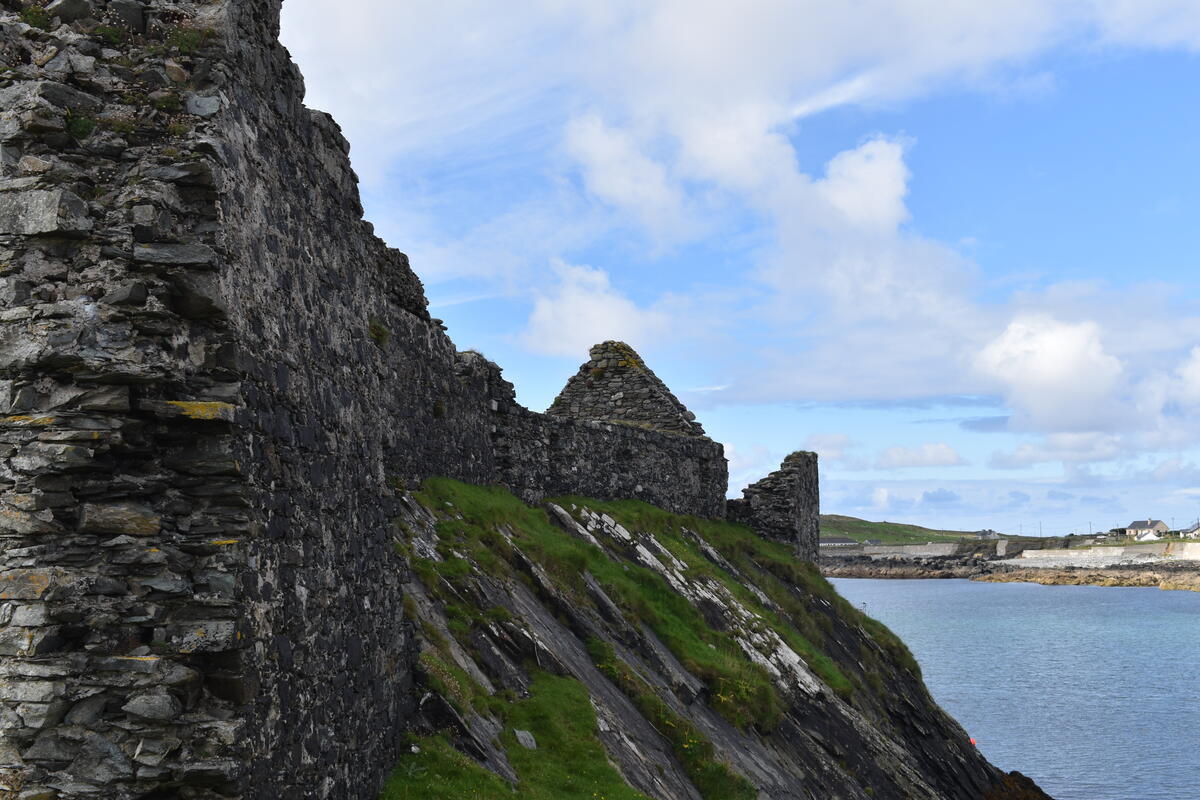
Inishbofin — in Irish, Inis Bó Finne, "the island of the white cow" — sits roughly seven miles off the Connemara coast in north-west County Galway. It has around 180 year-round residents, a single national school, three churches in various states of use and ruin, and a working harbour at Bofin where the Cleggan ferry docks several times a day in summer.
Getting there
The Inishbofin Ferry sails year-round from Cleggan pier, an hour and a half by road from Galway city via Clifden. Tickets can be booked online or at the Cleggan office (eircode H71YP11) before sailing. The crossing takes about half an hour. There are no cars available to hire on the island; visitors walk, cycle (bikes can be hired in Bofin) or use the small minibus service that meets some sailings.
Cromwell's Barracks
The most striking building on the island is a star-shaped stone fort overlooking the harbour entrance, locally known as Cromwell's Barracks. It was built in the 1650s during the Cromwellian conquest of Ireland, when Inishbofin became a holding camp for Catholic priests awaiting deportation to the Caribbean and the European continent. The site is reached on foot from the harbour and is freely accessible; nothing remains roofed, but the bastions and curtain walls are largely intact.
The beaches
Inishbofin has three beaches that draw most of the island's day visitors: East End Beach, Dumhach (the long sand strand near the harbour) and Trá Gheal — the "bright beach" — on the north of the island. All three are unsupervised and often empty even on warm August days. The water is clear and cold; swimmers and snorkellers are common in summer.
Walking the looped trails
The island has three colour-coded looped walking trails developed under the Connemara Walking Trails programme — the Westquarter, Cloonamore and Middlequarter loops — each between five and eight kilometres and waymarked from near the harbour. Between them they cover most of what is worth seeing on the island: the cliffs at Dún Mór, the seabird colonies on the western headlands, the small lakes at Lough Bofin and the seventh-century monastic site associated with Saint Colmán, the island's founding monastic figure.
Eating, sleeping, drinking
Accommodation on Inishbofin includes two hotels — the Inishbofin House Hotel and the Doonmore Hotel — plus several B&Bs, self-catering cottages and a hostel. There are a small number of pubs and cafés clustered near the harbour; food is sourced locally where possible, and seafood, especially crab and lobster landed at Bofin, is the standout. In 2011 Inishbofin was a recipient of an EDEN award (European Destinations of Excellence) for sustainable tourism, recognition of how the island's small community has built its visitor economy without overwhelming the place.
What it is, and what it isn't
Inishbofin is not the Aran Islands. It is smaller, quieter and less visited; there is no equivalent of Dún Aonghasa, no fleet of tour minibuses, and the cultural draw is the rhythm of the place itself rather than a single headline monument. For visitors who already know Connemara and want to extend a few hours into a slow day or two on a working Atlantic island — without the crowds of Inis Mór in July — it is one of the most rewarding short crossings in Ireland.