Ireland is an ancient country. The phrase is used so often in tourism literature that it has become almost meaningless — a comfortable shorthand for stone walls and ruined abbeys and a vague sense of deep time.
Standing inside the passage chamber at Newgrange on a winter morning as the first light of the solstice sun enters through the roof box and floods the chamber with gold, the phrase becomes something else entirely. It becomes true.
These three sites — Newgrange in County Meath, the Rock of Cashel in County Tipperary and the Hill of Tara in County Meath — are not tourist attractions in any ordinary sense. They are places where Ireland's deepest history is physically present, where the people who built this civilisation left evidence of their intelligence, their beliefs and their ambition that has survived for millennia.
Here is what you need to understand before you visit.
Newgrange — Older Than the Pyramids
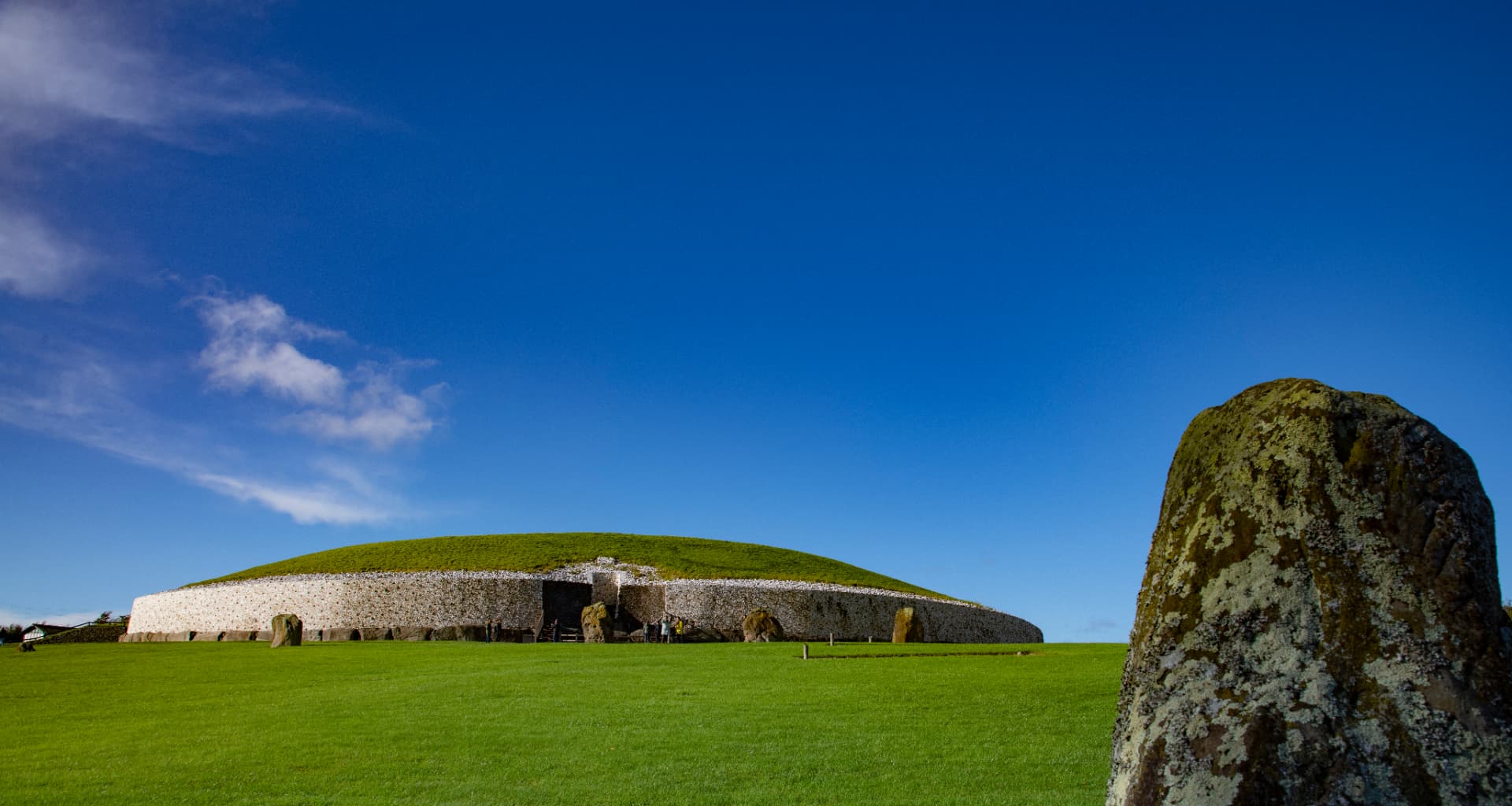
In the Boyne Valley in County Meath, on a low ridge above the River Boyne, stands a circular mound of earth and stone 85 metres in diameter and 13 metres high. It was built by Neolithic farmers around 3200 BC — making it more than 500 years older than the Great Pyramid at Giza and approximately 1,000 years older than Stonehenge.
The people who built Newgrange did not have metal tools. They did not have the wheel. They moved an estimated 200,000 tonnes of material — river boulders, quartz, earthen mound material — and constructed a passage tomb of such precision that, 5,200 years later, a narrow beam of light enters through the roof box above the entrance at dawn on the winter solstice and travels 19 metres down the passage to illuminate the chamber floor. Exactly as it was designed to do.
The engineering required to achieve this — the calibration of the roof box, the 1.5 degree incline of the passage floor, the corbelled vault of the chamber ceiling that has kept the interior bone dry for five millennia — represents a level of astronomical knowledge, planning and construction skill that continues to astonish contemporary archaeologists.
The entrance stone, decorated with the famous triple spiral motif, is one of the most recognised works of prehistoric art in the world. The kerbstones that ring the base of the mound contain more than a hundred decorated stones — abstract spirals, lozenges and zigzag patterns carved by hands working by firelight more than five thousand years ago.
Access to Newgrange is exclusively through the Brú na Bóinne Visitor Centre, across the river from the site. The guided tour takes visitors through the passage and into the chamber. The winter solstice lottery — for places inside the chamber at dawn during the five days around 21 December — attracts tens of thousands of applications for a handful of spaces. It is one of the most sought-after experiences in Irish cultural life.
The Rock of Cashel — Where Saint Patrick Met the High Kings
In the middle of the Golden Vale in County Tipperary, rising abruptly from the flat surrounding plain, is a limestone outcrop carrying one of the most dramatic medieval complexes in Europe.
The Rock of Cashel was the traditional seat of the Kings of Munster for centuries before it became associated with the Christian church. According to legend — and in this case, legend and history are closely intertwined — it was here that Saint Patrick arrived in the fifth century to convert the High King Aengus to Christianity. Using a shamrock leaf to explain the mystery of the Trinity, he is said to have accidentally driven his crozier through the king's foot during the baptism. The king, assuming it was part of the ceremony, endured the pain without complaint.
Whether the story is precisely true is less important than what it signifies: this was the place where two of the great forces that shaped Irish civilisation — the ancient Gaelic kingship and the new Christian faith — encountered each other on equal terms.
The buildings that remain on the Rock today span more than a thousand years of history. The round tower — one of the finest surviving examples in Ireland, dating from the twelfth century — stands to its full original height. Cormac's Chapel, built between 1127 and 1134 by the King-Bishop Cormac Mac Cárthaigh, contains some of the most significant Romanesque architecture in Ireland and the remains of extraordinary frescoes that represent the most important surviving example of Irish medieval painting. The Gothic cathedral, roofless now but still vast in scale, dominates the complex. The Hall of the Vicar's Choral houses the original St Patrick's Cross — a twelfth-century high cross of exceptional quality.
The views from the Rock across the Golden Vale are, on a clear day, among the most panoramic in Ireland. Forty kilometres of the central plain in every direction, green and flat and ancient, stretching to the distant hills of Kilkenny and Limerick.
The Hill of Tara — Seat of the High Kings
A low green hill in County Meath, thirty kilometres north of Dublin. Unremarkable in appearance. Incomparable in significance.
The Hill of Tara was for centuries the ceremonial and political capital of ancient Ireland — the seat of the High Kings, the site of coronations, the location of the great seasonal assemblies at which the laws were proclaimed and the business of the kingdom conducted. In pre-Christian Ireland, Tara was also the dwelling place of the gods and the entrance to the Otherworld — a place where the boundaries between the human and the divine were understood to be thin.
The evidence of human occupation here stretches back six thousand years. The Mound of the Hostages — a passage tomb contemporary with Newgrange — dates from around 3400 BC and sits at the northern end of the complex. The Rath na Ríogh, or Fort of the Kings, is a large Iron Age enclosure within which the most important monuments are located. In its centre stands the Lia Fáil — the Stone of Destiny — an upright pillar stone said in legend to roar when touched by the rightful king of Ireland. 142 kings are said to have been crowned here across the span of Irish history.
A recent archaeological survey found at least 100 previously unknown monuments beneath the Hill's surface — including a major temple directly under the hill, with the oldest features dating back 6,000 years. The visible landscape is only the smallest part of what lies here.
Tara is an open site — free to visit at any time. There is a small visitor centre in the old church beside the hill. But the experience that most visitors remember is simpler than any exhibition: the walk to the top of the hill, on a clear day, when the view extends across most of the midlands of Ireland, and something about the scale and the age of the place makes the modern world feel briefly, usefully, very small.
Planning Your Visit
All three sites are accessible from Dublin in a day, though each deserves more time than a day trip allows.
Newgrange is 50 kilometres north of Dublin. The Brú na Bóinne Visitor Centre is open year-round; advance booking for the guided tour is strongly recommended. The Hill of Tara is 10 kilometres south of Navan in County Meath — accessible by car and open at all times. The Rock of Cashel is 60 kilometres south of Limerick city; opening hours and admission prices are available at heritageireland.ie.
Visit them in sequence over two days and you will have covered five thousand years of Irish history. You will also — if the weather cooperates and you give each site the time and attention it deserves — have had three of the most profound experiences Ireland offers any visitor.