Killarney National Park: Ireland's First National Park, Where Mountains, Three Lakes and a 5,000-Year-Old Deer Herd Share One Valley
10,236 hectares of oak and yew woodland below the McGillycuddy's Reeks, a wild red deer herd that has been here since the Neolithic, a fifteenth-century castle on Lough Leane, and a monastery on an island founded in 640 AD — and the park itself costs nothing to walk into.
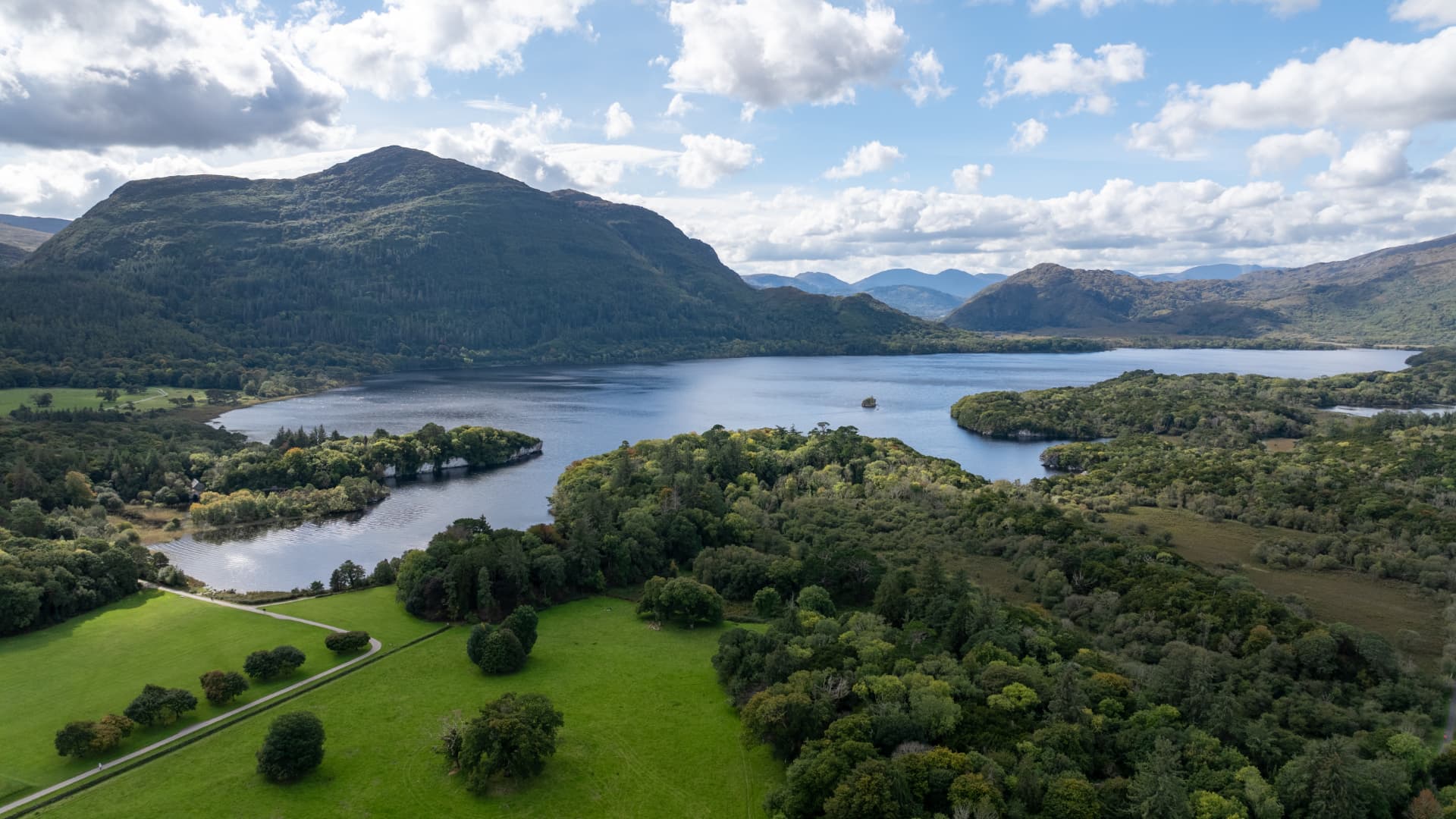
There is a reason Killarney has been written about for two hundred years, and it is not the town. South and west of Killarney itself the ground rises into the McGillycuddy's Reeks — the highest mountain range in Ireland — and then drops back down to three freshwater lakes set in 10,236 hectares of oak and yew woodland, bog and waterfall. That single continuous landscape, kept intact since 1932, is Ireland's first National Park, and more than 1.5 million people walked some part of it in 2025.
What catches people out is the scale. The park covers 25,425 acres and incorporates the three Lakes of Killarney, the Muckross and Kenmare Estates, Torc Mountain, Mangerton Mountain and the Purple Mountains. You can spend a morning here or a week, and most of it — the trails, the woodlands, the lakeshore, the deer — is free and open year-round. The paid parts are the historic houses and the boat trips, and even those are cheap for what you get.
Given to the State in 1932, and Still Free to Walk Into
Killarney National Park was created when the Muckross Estate — the Bourn Vincent Memorial Park — was presented to the Irish Free State in 1932, making it the first of Ireland's national parks. The State has extended it several times since, and it now sits within the Kerry UNESCO Biosphere Reserve and is designated a Special Area of Conservation under the EU Habitats Directive. It is twinned with Glacier National Park in Montana.
The park is managed by the National Parks and Wildlife Service, and the headline figure for 2025 is that 1,543,343 people visited Killarney National Park in the year — a 10 per cent increase on 2024, according to NPWS figures reported by Radio Kerry in January 2026. Muckross House welcomed 966,210 visitors through its doors in the same year, and Killarney House and Gardens a further 367,303. Across all NPWS-managed sites in Kerry the 2025 total was 2,876,856 visits. The park itself remains free to enter; the charges are for the house, the traditional farms, Ross Castle tours and the boat operators.
The Three Lakes and the Reeks Above Them
The three Lakes of Killarney — Lough Leane, Muckross Lake and the Upper Lake — together account for roughly a quarter of the park's area. Lough Leane is the largest, with more than thirty islands scattered across it, including Innisfallen. Muckross Lake is the deepest of the three, reaching about 73.5 metres, with the slopes of Torc Mountain coming down to its shore. The Upper Lake sits higher and more remote, walled in by the Purple Mountains and the McGillycuddy's Reeks, and the three are connected by the Long Range River and the Meeting of the Waters — the narrow channel where the lower lakes meet, and the most photographed stretch of water in the park.
Above the lakes the McGillycuddy's Reeks run west, with Carrauntoohil — at 1,039 metres the highest point in Ireland — at their head. You do not have to climb any of them to feel the scale; the Reeks form the western wall of the park and are visible from almost every trail on the lower ground. Ladies View, a pull-in on the N71 above the lower lakes, is named for Queen Victoria's ladies-in-waiting and is still the single best free viewpoint in the park.
Red Deer Since the Neolithic, and Europe's Largest Yew Wood
Two things in the park exist nowhere else in Ireland in the same form. The first is the red deer herd. The Killarney red deer are the last surviving indigenous herd of red deer in Ireland, and they have been here since Neolithic times; every other red deer herd in the country is descended from re-introduced stock. They are Ireland's largest native land mammal and can be seen on the slopes of Torc and Mangerton and grazing the pasturelands at Knockreer. Sika deer, introduced in the nineteenth century, are also present in the park.
The second is the Reenadinna yew woodland on the Muckross peninsula — the largest area of yew woodland in Western Europe and a designated Special Area of Conservation in its own right. The trees within it are estimated to be between 200 and 250 years old, growing on bare limestone pavement where almost nothing else can take hold. The park's older native oak woodlands, around Derrycunihy, are among the largest remaining stands of semi-natural oak in the country. Dogs are welcome on the trails but must stay on the lead, and the NPWS asks visitors to keep to marked routes — only experienced hillwalkers should venture onto the open mountain.
Muckross House, Ross Castle and an Island Monastery
Muckross House is the focal point of the park, a Victorian mansion built between 1839 and 1843 by the Scottish architect William Burn for Henry Arthur Herbert and his wife, the watercolourist Mary Balfour Herbert. The gardens were extended in the 1850s ahead of a visit by Queen Victoria, and the Sunken Garden, Rock Garden and Stream Garden were added later by the Bourn Vincent family. The house is preserved as a late-nineteenth-century mansion with original furnishings. Admission is €7 for an adult, €12 for a combined house and farms ticket, and no pre-booking is required — tickets are bought at reception. In 2026 the house is open daily, 9.15am to 5.30pm January to March and November to December (last admission 4pm), 9.15am to 6pm April to June and September to October (last admission 4.40pm), and 9.15am to 7pm July to August (last admission 5.40pm). The Muckross Traditional Farms, a separate ticket, run from mid-March to October. The Muckross Gardens are free to walk through.
Ross Castle is a five-storey tower house built in the fifteenth century, probably by the O'Donoghue Mór clan, on an inlet of Lough Leane. It is famous for being the last place in Munster to hold out against Cromwell — it fell in 1652 only after Parliamentarian artillery was floated onto the lake by boat, fulfilling a local prophecy that the castle would never fall until a warship sailed on the water. It is an Office of Public Works site, open from 5 March to 3 November 2026, daily 9.30am to 5pm, with the first guided tour at 10am and the last at 4.55pm. Access to the interior is by guided tour only, first-come first-served, maximum fifteen people per tour, and adult admission is €5 (family €13). It is a busy site in summer — arrive for the first tour if you want to get in without a wait.
Out on Lough Leane, 1.5km from Ross Castle, sits Innisfallen Island. A monastery was founded there around 640 AD by St Finian the Leper, and the island became an important seat of learning — Brian Boru is said to have been educated there, and the Annals of Innisfallen, one of the key medieval Irish manuscripts, was written by its monks. The ruins on the island today include a twelfth-century Augustinian priory and an eleventh- to twelfth-century Romanesque church. Boat trips to Innisfallen run from Ross Castle and Reen Pier through the licensed operators; red and sika deer are sometimes seen among the ruins. The Meeting of the Waters and the full lake tour to the Gap of Dunloe are also run from Ross Castle.
Torc Waterfall, Ladies View and How to Actually Do It
Torc Waterfall is the park's most accessible landmark — a short, signed walk from the Muckross House car park up through moss-covered oak woodland to a waterfall that drops about twenty metres off the side of Torc Mountain. The path is level enough for most walkers and is one of the busiest in the park, so go early. From the waterfall a steeper climb leads to the top of Torc Mountain and panoramic views back across the lakes; the lower trail is the one most people do.
The N71 is the road that threads the park from Killarney town to Kenmare, and the two stops along it that everyone should make are Molls Gap and Ladies View — both free, both with parking, both giving you the high view across the lakes and the Reeks that the lower trails cannot match. The Muckross to Dinis cycling and walking loop is the best flat circuit in the park, roughly 15km round the lower lakes and through Reenadinna yew wood, with bike hire available at Muckross. Killarney House and Gardens, at the town end of the park, is the formal entrance: a restored house with a free interactive exhibition on the park's history, open Thursday to Monday 9.15am to 5.15pm (last entry to the exhibition 5pm), and the gardens are free.
Killarney town is the base — reachable by direct train from Dublin Heuston and Cork Kent, and by bus — and the park begins at the edge of it. Two free car parks serve Ross Castle, about 100 metres from the entrance, and they fill quickly on summer weekends; the Muckross House car park is the better option if you are starting from the lakes. Allow a full day. If you only have a few hours, walk from Muckross House to Torc Waterfall and back along the lake, then drive up to Ladies View. The park is open year-round and the gardens are free, but Ross Castle, the Muckross House interior and the traditional farms all close for part of the winter.
The Bottom Line
Killarney National Park is the one Irish attraction that genuinely earns the word "unmissable," and almost all of it is free. Walk into Muckross House and Gardens, do the short trail to Torc Waterfall, take a boat from Ross Castle out to Innisfallen, and drive the N71 up to Ladies View — that is a full day for the price of a house ticket (€7) and a boat trip. The red deer herd, the Reenadinna yew wood and the fifteenth-century castle are things you will not find together anywhere else in the country, and 1.5 million people a year are not wrong about it. Go early in the day, keep your dog on a lead, and the park will do the rest.