Kilmainham Gaol: The Prison Where Ireland Was Made
Opened in 1796, closed in 1924, and rescued from ruin by volunteers in time for 1966. From the United Irishmen to the stone-breakers' yard of 1916, almost every convulsion in Irish history passed through these cells.
On Inchicore Road, a kilometre west of the Guinness Storehouse, sits the building that more than any other tells the story of modern Ireland. Kilmainham Gaol opened in 1796 as the County of Dublin Gaol and closed in 1924, and in the 128 years between, almost every convulsion in Irish history passed through its cells. United Irishmen after 1798. Robert Emmet's rebels in 1803. Charles Stewart Parnell in 1881. The Invincibles in 1883. The leaders of 1916. The last prisoners of the Civil War. One of them was Éamon de Valera, who would return forty-two years later as President to open the museum the volunteers had rescued from ruin.
The New Gaol of 1796
The prison that Kilmainham replaced was a medieval dungeon near present-day Mount Brown — underground cells, no hospital, prisoners drinking spirits bought through the windows from friends in the street. A parliamentary committee in 1782 called it "extremely insecure, and in an unwholesome bad situation." The replacement was built on Gallows Hill, chosen for its elevation and drainage, and designed by the architect John Trail at a cost of £22,000 to the Grand Jury of County Dublin. Construction began in 1786 and the new gaol opened in 1796, built of limestone and granite, with two wings flanking a central block where the gaolers lived.
The entrance block survives from that first building, and it is worth stopping to read. Above the doorway is a chained hydra — the many-headed serpent of Greek myth — and public hangings were once carried out from a gallows directly above the entrance. The message was deliberate: the state chaining the monster of disorder. Public hangings at the front gate had largely stopped by the 1820s, but the stone and the symbol remain.
Two Wings, Two Centuries
The West Wing is the oldest part of the gaol that survives in its original state. It is gloomy, dark, and cold — when first built there was no glass in the windows, no heating, no light, only candles. There are now seventy-nine cells, though originally there were fewer, as extensions were added through the nineteenth century. Gaslight came in the 1840s. The political prisoners who passed through this wing include members of the United Irishmen after the 1798 and 1803 rebellions, and the leaders of the Easter Rising in 1916 — Patrick Pearse, Thomas MacDonagh, Constance Markievicz, Thomas Clarke, and Michael Mallin among them.
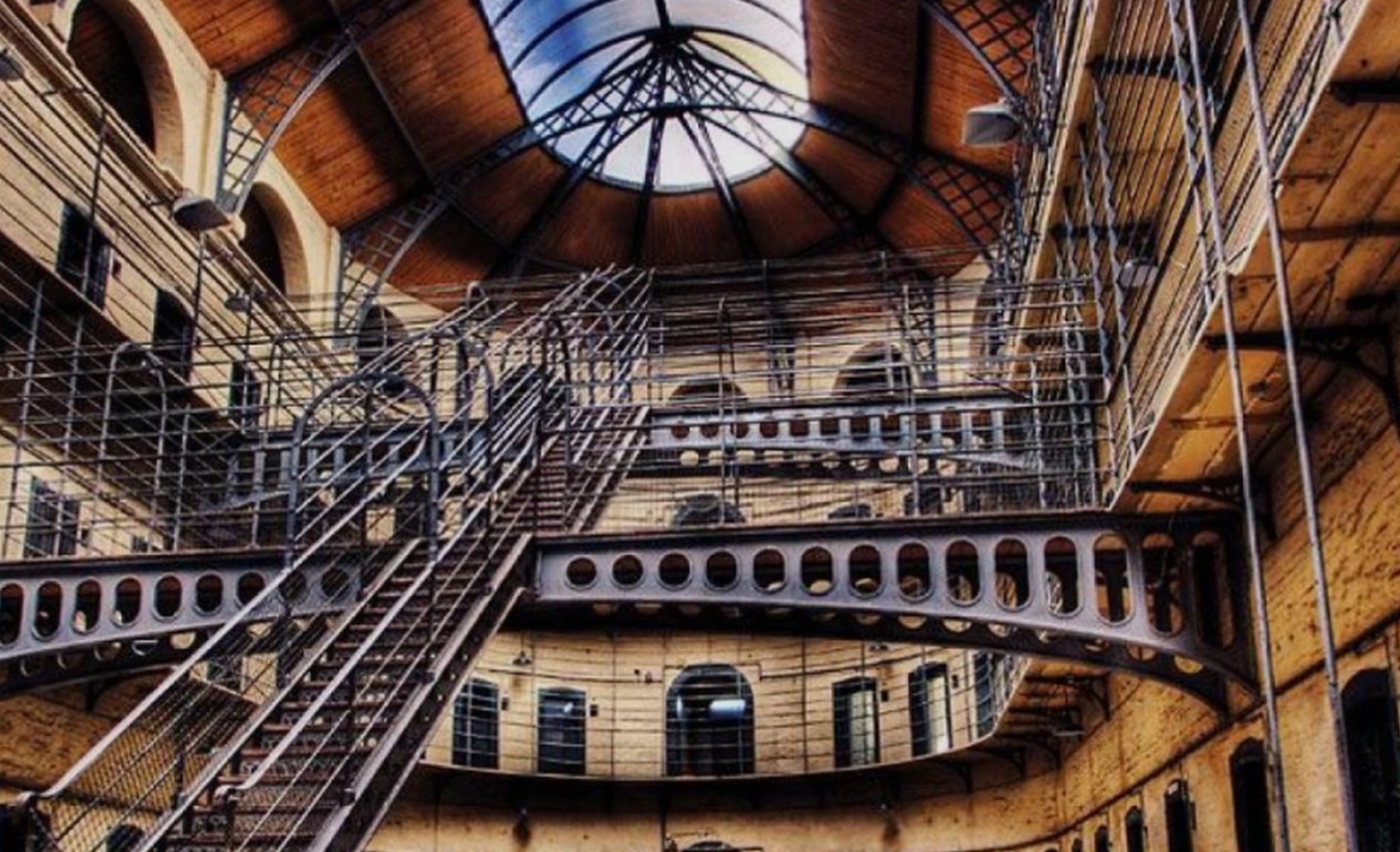
The East Wing, built around 1860, is the Victorian addition — a three-storey over raised basement structure of snecked cut limestone with a vaulted rooflight, cast-iron walkways, and a central spiral staircase. It was designed on the principle of separation: prisoners in individual cells, under the surveillance of a single guard at the centre. Today this wing houses the museum exhibition across three levels.
The Stone-Breakers' Yard and the Fourteen
The emotional centre of Kilmainham Gaol is the stone-breakers' yard. Between 3 and 12 May 1916, fourteen leaders of the Easter Rising were executed there by firing squad. The first was Patrick Pearse, Commander-in-Chief of the Irish Volunteers. The last was James Connolly, wounded during the Rising and executed seated on a chair because he could not stand. In between, Joseph Plunkett was allowed to marry his fiancée Grace Gifford in the Catholic chapel inside the gaol, by candlelight, a few hours before he was shot. The wooden altar in that chapel was made in 1882 by James Lalor, a Belfast carpenter who was himself an inmate at the time.
Those executions changed Ireland. Public opinion, which had been indifferent or hostile to the Rising, turned sharply against British rule. The last 1916 prisoners were released under amnesty in June 1917 and greeted as heroes. Within five years the country was in the War of Independence, and within seven the Civil War — the last conflict whose prisoners were held in Kilmainham. The gaol closed for good in 1924.
Rescue and Restoration
After 1924 the building was left to rot. Trees took root in the yards. Glass broke, iron rusted, and successive governments let it decline because the memories were still too raw. In the late 1950s a group of veterans and volunteers, led by men like Lorcan Leonard, came together with a plan to restore the gaol as a memorial in time for the fiftieth anniversary of the Easter Rising in 1966. They wrote to the Old IRA asking for help to "elevate that weed-grown, debris-strewn yard of which you are aware, to the most holy spot in Ireland."
They met their goal. In April 1966 the museum was opened by President Éamon de Valera — who had been one of the last prisoners released from Kilmainham in 1924. The Kilmainham Jail Restoration Society then spent another twenty years doing voluntary repair work: removing trees and pests, replacing broken glass and rotted ironwork. Today the building is run by the Office of Public Works as a museum of Irish nationalism, and the exhibition on the top floor tells the story of those volunteers.
What You Will See — and How to Get In
The museum's three floors cover the social history of the prison in the 1800s, the history of Irish nationalism from 1796 to 1924, and the restoration story. The ground floor tells it from the ordinary prisoner's perspective — the prison register shows crimes ranging from violent assault to stealing apples from an orchard, and a small wooden box carried by convict John Sheahan to Australia in 1842 is on display. The first floor holds Robert Emmet's 1803 proclamation of a provisional government, the last letter of Charles Stewart Parnell, scapulars taken from the body of Michael Collins, and the "Last Words" section — the final letters and belongings of the fourteen executed leaders of 1916. A temporary exhibition, "The Prisoners' Lens: Secret photography in Kilmainham Gaol, 1921," runs from 23 October 2025 to 31 October 2026.
Access to the gaol is by guided tour only. The tour takes one hour, and you should allow ninety minutes in total to see the museum afterwards. Tickets are €8 for adults, €6 for seniors, €4 for students and children aged 12 to 17, free for under-12s (a ticket is still required), and €20 for a family of two adults and two or three children. You must pre-book online — this is not a place you can walk up to. Tickets are released twenty-eight days in advance at midnight Irish time, and a small batch of additional and cancellation tickets goes live each morning from 9:15am. The only legitimate booking sites are kilmainhamgaolmuseum.ie and heritageireland.ie. The gaol warns that fraudulent websites and resale platforms are active, and tickets bought from third parties will not be honoured.
The gaol is open year-round except 24 to 27 December. The Courthouse Visitor Centre opens at 9:30am and the museum at 10:30am, with last entry at 5:15pm. There is no on-site parking; the nearest paid car park is at the Irish Museum of Modern Art and Royal Hospital Kilmainham, a five-minute walk away. Brambles café and the gift shop are in the Courthouse and require no ticket. The gaol is not recommended for children under six, there are no buggies allowed on the tour, and in winter the building is very cold — dress for it. There are no secure lockers for luggage.
The Bottom Line
Kilmainham Gaol is the place to go in Dublin for anyone who wants to understand how Ireland became Ireland. It is not a comfortable visit — it is cold, dark, and the stone-breakers' yard is devastating — but the guided tour is exceptional and the museum's collection of original letters and objects is unlike anything else in the country. Book early, bring a coat, and allow the full ninety minutes. You will not forget it.