The Peninsula Most People Miss
Most visitors driving south through County Clare toward Kerry follow the N68 inland from Ennis, or take the coast road past Lahinch and the Cliffs of Moher before crossing the Shannon at Tarbert. What almost nobody does is continue past Kilkee and Kilrush to the very tip of the peninsula that extends southwest from the main body of Clare into the Atlantic — the Loop Head Peninsula, a narrow finger of land with the Shannon estuary on its southern side and the full open Atlantic on its north, culminating at Loop Head lighthouse at its western tip. This oversight, shared by most Irish and international visitors to Clare, makes Loop Head one of the genuinely hidden corners of a county that is itself often overshadowed by Galway and Kerry in the west of Ireland tourism conversation.
What Loop Head Actually Is
Loop Head is approximately 15 kilometres of peninsula, extending westward from Kilkee to the lighthouse at the Atlantic tip. The landscape is primarily farmland — small fields bounded by stone walls that run down to the clifftops on both sides of the peninsula — interspersed with the small villages of Kilkee, Carrigaholt, Cross and Kilbaha, each with a distinctly different character. Kilkee is the largest settlement and the most visitor-oriented, with a horseshoe bay, a tidal swimming pool — the Pollock Holes, a network of natural rock pools that have been used for bathing since Victorian times — and a compact town with restaurants, cafés and accommodation.
Carrigaholt, on the southern shore of the peninsula overlooking the Shannon, is a quieter village with a working harbour, a 15th-century castle overlooking the water and one of the most reliable cetacean-watching locations in Ireland. The Shannon Estuary supports a resident population of approximately 130 bottlenose dolphins — one of only two resident populations of bottlenose dolphins in Ireland and the larger of the two — and boat trips from Carrigaholt operated by Dolphinwatch give visitors close-range encounters with these animals in their natural habitat. Sightings are not guaranteed, but the company's years of operating in the estuary give the guides a detailed knowledge of the dolphins' movements and behaviour that makes encounters more likely and more meaningful when they occur.
Loop Head Lighthouse: The End of Ireland
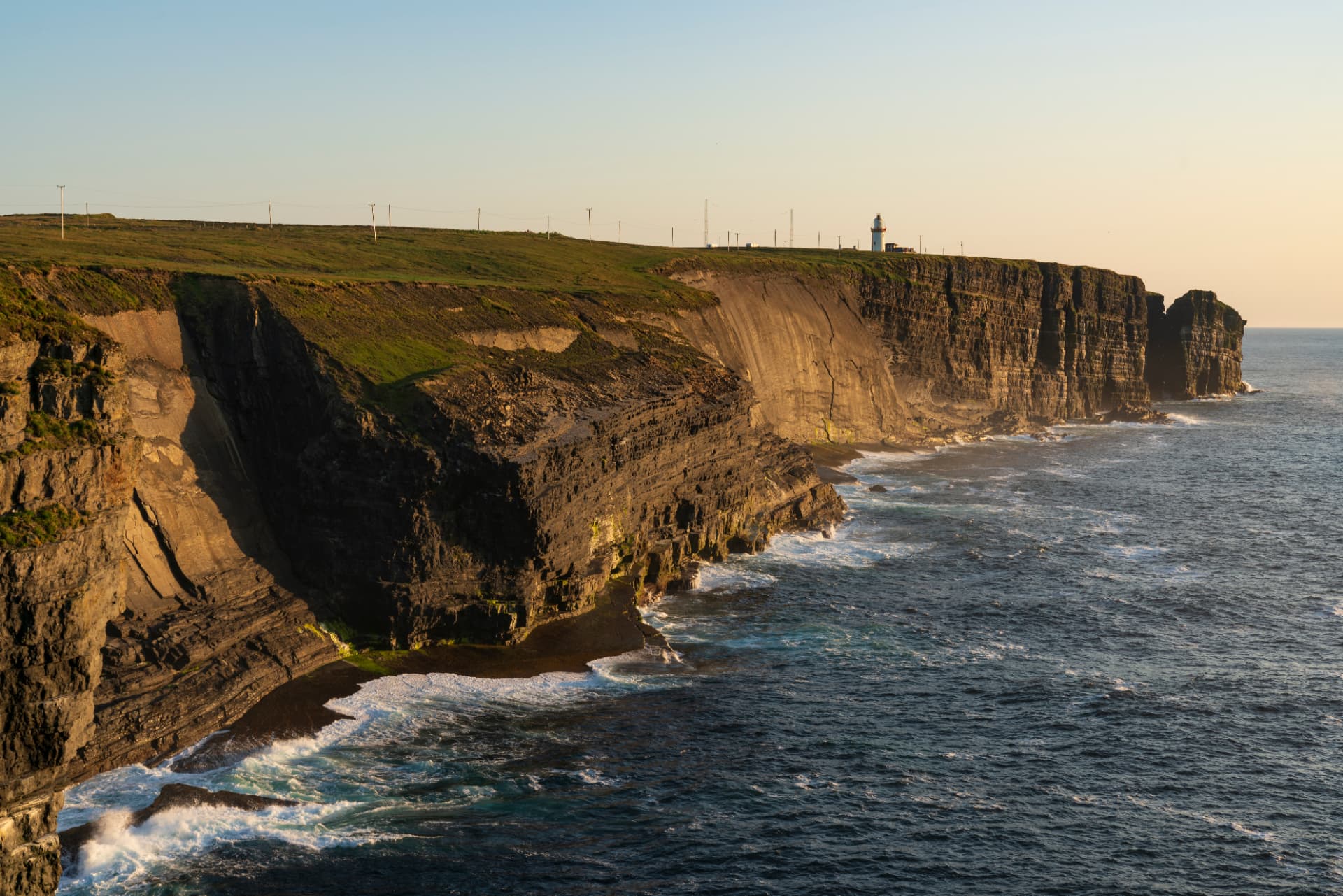
The Loop Head lighthouse, operated by Irish Lights since 1854, sits at the westernmost point of the peninsula — a white tower on a headland where the land ends in a series of fractured cliff faces and sea stacks, the Atlantic visible in all directions. The lighthouse is open to visitors during the summer season, with access to the tower and the surrounding headland. The view from the lighthouse platform — on a clear day — takes in the Aran Islands to the north, the mountains of Kerry to the south across the Shannon mouth, and the open Atlantic to the west with nothing between you and North America but water.
The clifftop walk from the lighthouse north along the Atlantic face of the peninsula is, mile for mile, among the finest cliff walks in Clare — and Clare has competition from the Cliffs of Moher for the title of best coastal walking in the west. The Loop Head cliffs are less visited, less managed and considerably more dramatic in their formation than the Moher cliffs at their central section — a series of sea stacks, collapsed caves and natural arches cut into the folded rock by Atlantic wave action over millennia.
The Vandeleur Walled Garden, Kilrush
At the eastern end of the Loop Head Peninsula, in the market town of Kilrush, a Victorian walled garden has been restored to remarkable condition and opened to the public. The Vandeleur Walled Garden — originally created in the 19th century by the Vandeleur family, the Anglo-Irish landlords who dominated Kilrush and its surroundings through the famine era — was restored in the 1990s and now operates as a woodland garden and public amenity, with an impressive collection of mature trees, winding woodland paths and a restored glasshouse range. The combination of the garden's historical associations — the Vandeleur family's role in the clearances of the Kilrush Union during the Great Famine is documented and discussed in the garden's interpretive material — and its genuine horticultural beauty makes it one of the more thought-provoking public gardens in Munster.
The Practical Case for Loop Head
Loop Head is within easy day-trip distance of Ennis, Limerick, Galway and, with an early start, Dublin. The Shannon car ferry from Tarbert in Kerry to Killimer at the base of the Loop Head Peninsula allows the peninsula to be incorporated into a circular route that avoids retracing the same roads — crossing from Kerry to Clare in approximately 20 minutes, exploring the peninsula, and returning to Ennis or Limerick along the north Clare coast. The ferry runs every hour on the half-hour throughout the summer season.
The combination of the dolphin-watching boat trips from Carrigaholt, the clifftop walking at Loop Head, the Pollock Holes swimming at Kilkee and the Vandeleur Garden in Kilrush gives the peninsula a full day's activity for almost any type of visitor — and the low visitor numbers that currently characterise most of the peninsula outside Kilkee mean that all of those experiences feel genuinely personal rather than managed.
The Bottom Line
Loop Head Peninsula is Clare's hidden card — a fifteen-kilometre finger of Atlantic coastline with dolphin-watching, lighthouse walks, dramatic cliff scenery, Victorian gardens and genuine Irish village character that most visitors to the county never find because they leave Clare before they get this far south. The Shannon car ferry makes it practical to include in a Kerry-to-Clare circuit without backtracking. The views from the lighthouse, the dolphins in the estuary and the emptiness of the cliff walk on a July afternoon make it worth the drive on its own merits.