The National Gallery of Ireland: One Million Visitors a Year and Free to Walk In
A 160-year-old collection on Merrion Square that holds a rediscovered Caravaggio, a January tradition of Turner watercolours, and the full sweep of Irish art — and it costs nothing to enter. Here is what is inside, and what is coming in 2026.
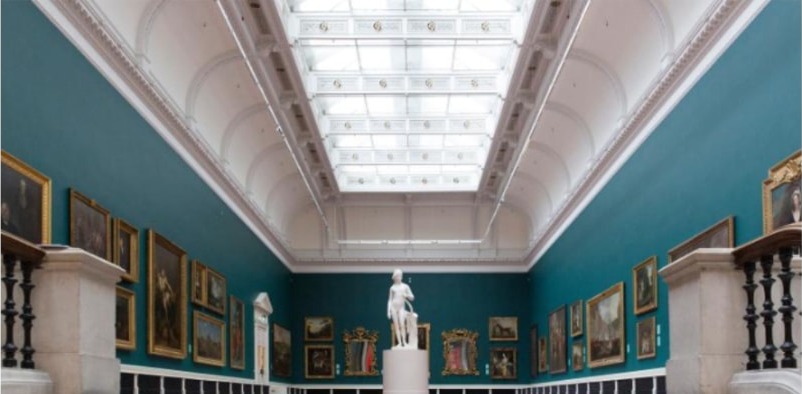
There is a particular kind of surprise that catches you on the steps of the National Gallery of Ireland: the surprise of learning that one of Europe's finest public art collections, holding a Caravaggio, a Vermeer, a Monet and the greatest body of Irish painting anywhere, charges nothing to walk through its doors. No booking, no turnstile, no ticket. You step in off Merrion Square and you are standing in front of Old Masters within a minute.
In 2025, 1,049,683 people did exactly that. It was the third consecutive year the Gallery welcomed over one million visitors — a figure driven, the Gallery says, by a run of critically successful exhibitions including Turner's Watercolours: Scotland's Vaughan Bequest, Mainie Jellett and Evie Hone. The Art of Friendship, and Picasso: From the Studio, alongside the annual AIB Portrait Prize. For a free, national institution sitting at the quieter end of Dublin's museum quarter, that is a serious audience.
A Gallery Born from an Exhibition
The National Gallery of Ireland traces its origins to the Great Industrial Exhibition of 1853, underwritten by William Dargan — the engineer widely regarded as the father of the Irish rail network. The crowds that flooded the exhibition demonstrated a public appetite for art, and a committee called the Irish Institution was formed to campaign for a permanent national gallery. The campaign succeeded: the National Gallery of Ireland Act was passed in 1854, and on 30 January 1864 the Earl of Carlisle officially opened the Gallery to the public with a collection of just 112 pictures.
The building was designed by Francis Fowke, who had also designed the Natural History Museum next door — and a condition of the commission was that the Gallery's exterior would replicate its neighbour. The two institutions still face each other across the same square, a matched pair of Victorian civic architecture. From 112 paintings, the collection has grown across more than a century and a half into one of the most significant holdings of European and Irish art on these islands.
The 2017 Rebirth
For much of the early 2010s the Gallery's historic Dargan and Milltown wings were behind hoardings. On 15 June 2017, after a multimillion-euro refurbishment carried out by the Office of Public Works with architects Heneghan Peng as design team leaders, the Gallery reopened with an entirely new presentation of its permanent collection. The project included a state-of-the-art underground energy centre, revealed nineteenth-century architectural features, and opened majestic windows onto a spacious, light-filled courtyard — the site of Magnus Modus, a dramatic sculptural commission by the Irish furniture-maker and artist Joseph Walsh.
The reopening hang placed the Gallery's strengths side by side: master paintings by Rembrandt, Caravaggio, Ruisdael, Vermeer, Gainsborough, Goya, Monet, Gris and Picasso, alongside the Irish collection — Daniel Maclise, Roderic O'Conor, John Lavery, William Orpen, Seán Keating, Gerard Dillon, Evie Hone, Norah McGuinness, Jack B. Yeats, Louis le Brocquy and William Scott. For the first time, the full span of Irish art — from the nineteenth century to the late twentieth — could be read in a single, continuous visit.
The Caravaggio in the Dining Room
The Gallery's most famous single work has one of the most improbable provenance stories in European art. Caravaggio's The Taking of Christ, painted around 1602, depicts the moment of Judas's betrayal in the artist's characteristic play of light and dark. For centuries it was considered lost — until 1990, when it was recognised hanging on a dining-room wall in a Jesuit house in Dublin, where it had been misattributed for decades. The painting was loaned to the Gallery and has remained one of its centrepieces ever since, drawing visitors from around the world to a single room.
Around it, the European collection tells a broader story: a Vermeer, Lady Writing a Letter, one of only a small number of Vermeers in any public collection; landscapes by Ruisdael; Goya and Gainsborough portraiture; Monet's impressions of light on water; the Cubist negotiations of Gris and Picasso. These are not supporting pieces — they are works that hold their own against any gallery in Europe.
The Irish Story on the Walls
If the European collection gives the Gallery its international weight, the Irish collection gives it its soul. Jack B. Yeats — brother of the poet — is represented by a body of work whose vivid, almost musical colour captures something of the west of Ireland that no photograph has matched. John Lavery's portraits and landscapes record Edwardian high society and the Irish War of Independence era alike. William Orpen, Seán Keating and Louis le Brocquy trace the line of Irish modernism across the twentieth century, while Evie Hone's stained-glass-informed abstraction and Norah McGuinness's structured modernism show the parallel strength of Irish women artists too often left out of the story.
The Gallery continued to deepen this collection in 2025. Among the year's acquisitions were Woman in costume (Self-portrait), 1917, by Kathleen Fox; Seated Woman Reading, 1884, by Frank O'Meara; and two works by the stained-glass and illustration master Harry Clarke — The Lady of the Decoration, 1914, and Faust, 1924/25. Each adds a thread to a collection that is, room by room, the most complete visual record of Irish artistic life anywhere.
What's On, and What's Coming in 2026
The Gallery's exhibition programme is the engine behind its million-strong audience, and the 2026 line-up is among its most ambitious. The year opens, as it always does, with Turner. The 31 watercolours by J.M.W. Turner — bequeathed by Henry Vaughan in 1901 and exhibited every January under the conditions of the bequest — returned to Dublin in January 2026 following a loan to the National Galleries of Scotland, shown alongside works by artists who found inspiration in Turner's mastery of light.
From 16 April to 19 July 2026, William Blake: The Age of Romantic Fantasy brings together over 100 works by the visionary poet-artist and his contemporaries, organised in collaboration with Tate and curated by the Gallery's Anne Hodge alongside Tate's Alice Insley. Rembrandt to Matisse — A Celebration of European Works on Paper is now open in the Print Gallery with free admission, drawing on the Gallery's rich holdings of prints and drawings. Later in the year comes Hilma af Klint: Artist and Visionary (15 October 2026 – 7 February 2027), the first major Irish presentation of the pioneering Swedish abstractionist, and Jan Steen: Sacred and Profane (21 November 2026 – 25 April 2027), exploring the theatrical Dutch storyteller. The AIB Portrait Prize and AIB Young Portrait Prize return through 2026, continuing the Gallery's annual celebration of contemporary Irish portraiture.
Beyond the exhibitions, the Gallery's 2025 programme also appointed its inaugural Cultural Art Psychotherapist in Residence — extending its work at the intersection of arts and health — and expanded its Schools Partnership with SMBC Aviation Capital to address barriers to arts access for children and young people across the country. It is the work of an institution that sees itself not just as a storehouse of paintings but as a public resource, and it is shaping its current Strategic Plan (2024–28) around exactly that ambition.
Planning Your Visit
The National Gallery of Ireland is at Merrion Square West, Dublin 2, with a second entrance on Clare Street. Admission to the permanent collection is free, and no booking is required — you simply walk in. Some temporary exhibitions carry a charge (for example, the Blake exhibition tickets run from €0 to €16), and exhibitions are free for members of the Friends of the National Gallery of Ireland. Carers can visit paid exhibitions free of charge, with a ticket booked in advance.
The Gallery is open seven days a week. Hours are Monday 11am–5.30pm, Tuesday and Wednesday 9.15am–5.30pm, Thursday 9.15am–8.30pm, Friday and Saturday 9.15am–5.30pm, and Sunday 11am–5.30pm. The galleries, including temporary exhibitions, begin to close at 4.50pm daily (7.50pm on Thursdays), starting with the upper floors — so arrive with time to spare rather than near closing. The Gallery is closed 24–26 December and on Good Friday.
Practical touches make a difference. There are self-service lockers at the Merrion Square entrance for bags and backpacks. The Atrium Creative Space is open year-round with drawing materials for anyone who wants to sit and make something of their own — a quietly excellent way to spend an hour with children. Free guided tours and self-led audio tours (on your own device and headphones) are available, and the Gallery Shop and Gallery Café both keep slightly shorter hours than the galleries themselves. The building is fully accessible; if you need accessibility assistance, contact info@ngi.ie before your visit or speak to any member of staff on arrival.
For context, the Gallery sits at the heart of Dublin's museum quarter. Trinity College and the Book of Kells are a few minutes' walk to the west; the Natural History Museum is next door; the National Museum of Ireland – Archaeology on Kildare Street is a two-minute walk away. A morning at the Gallery can extend naturally into a full day of Irish culture without crossing the river.
The Bottom Line
The National Gallery of Ireland is the rare institution that asks nothing of you at the door and gives you a Caravaggio, a Vermeer, a century and a half of Irish painting, and a million-visitor exhibition programme in return. The fact that it is free is not a footnote — it is the point. A national collection, open to all, seven days a week, in the middle of Dublin. Go on a Thursday, when the galleries stay open until 8.30pm, and the rooms quiet down after the day-trippers have gone. Stand in front of The Taking of Christ and think about the fact that it hung, unnoticed, in a Dublin dining room for decades. Then walk the Irish rooms and read the whole story of this country's art in a single afternoon. That is what a national gallery is for — and this one does it as well as any in Europe.