The Phoenix Park: A Royal Hunting Ground Turned Dublin's Back Garden, Still Free and Still Full of Deer
A herd of wild fallow deer descended from animals brought here in 1662, a rediscovered medieval tower house, the President's residence open on Saturdays, and 22 acres of Victorian flower gardens — a mile and a half from O'Connell Street, and it costs nothing to walk in.
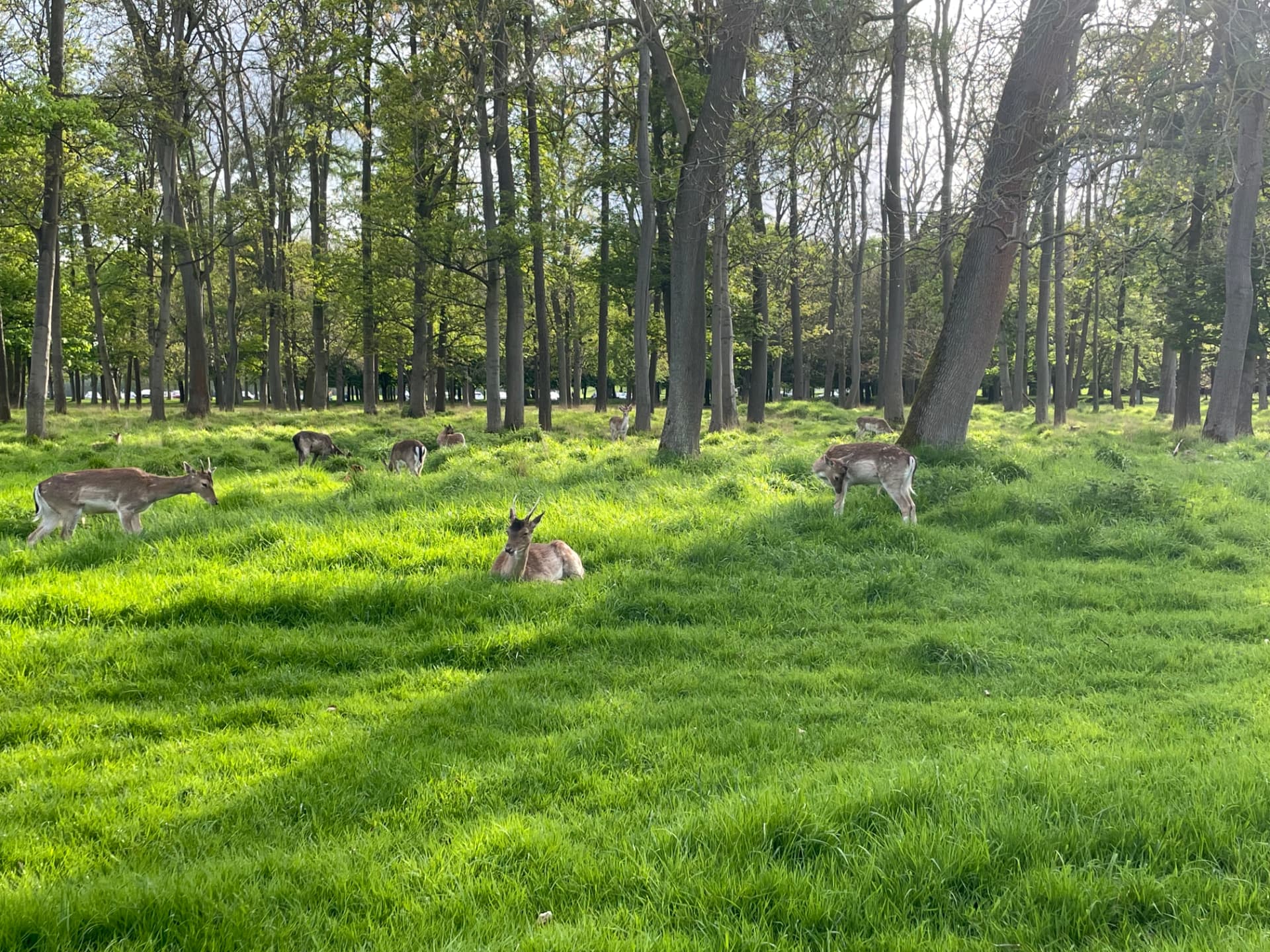
There is a moment that catches almost every first-time visitor to the Phoenix Park off guard. You walk in off a city street, follow a line of mature trees for ten or fifteen minutes, and then stop, because there is a herd of wild deer grazing in front of you — antlers, fawns, the whole thing — in a capital city a mile and a half from O'Connell Street. No enclosure, no ticket, no fence between you and them. Dublin has grown up around this herd rather than the other way round.
The Phoenix Park is one of the largest enclosed public parks in any capital city in Europe, and it is open twenty-four hours a day, seven days a week, all year round. Admission is free. The main gates at Parkgate Street and Castleknock Gate never close; the side gates run from roughly 7am to 10.45pm. The Office of Public Works suggests an average visit of three to four hours, which is about right if you intend to see more than the grass.
The Deer Came in 1662 and Never Left
The park was established as a royal deer park in 1662 by James Butler, Duke of Ormond, who imported fallow deer from Great Britain. Fallow deer have been here ever since, and some of the animals grazing the park today are descendants of those original arrivals of over 350 years ago. The park itself was formed as a royal hunting ground in the 1660s and opened to the public in 1747 — so the deer predate public access by more than eighty years.
The herd is now considered an integral part of the park's biodiversity, and the OPW is blunt that removing it would significantly change wildlife habitats here. Ninety per cent of the deer's diet is grass, with occasional browsing on leaves and seeds. That is the key to the one rule visitors most often break: do not feed them. Carrots, apples, bread, crisps and chocolate are not part of their diet, and well-meaning feeding is having a detrimental effect on both the animals' health and how they behave around people.
The second rule matters just as much. These are wild animals with unpredictable behaviour, and the OPW asks visitors to keep at least 50 metres between themselves and the deer — no selfies, and particularly no bringing children close to the bucks. Photograph them from a distance, as the picture above was taken, and everybody wins. For context, London's largest royal park, Richmond Park, keeps wild fallow deer on the same basis.
Ashtown Castle: A Medieval Tower Found Inside a Georgian House
The best story in the park is an architectural accident. Ashtown Castle is a tower house that probably dates from the seventeenth century and may be as early as the fifteenth, and for years it was completely hidden inside the walls of a Georgian mansion occupied by the Under-Secretary for Ireland. When that house was demolished in the late 1980s, the castle was rediscovered inside it. It has since been fully restored and now welcomes visitors.
Free tours of the castle run from the Phoenix Park Visitor Centre beside it, Monday to Friday from January to December at 10.30am, 12pm, 1.30pm, 3pm and 4pm, subject to availability — worth a call to the centre on 01 677 0095 to confirm the time before you travel. The Visitor Centre itself is open seven days a week, 9.30am to 6pm, with last admission 45 minutes before closing, and it is closed on Mondays and Tuesdays from January to mid-April. Admission is free. Inside is a self-guided exhibition interpreting the park from 3500 BC to the present, plus a twenty-minute audio-visual presentation on either the park through the ages or the history of Áras an Uachtaráin. The eircode is D08 Y304.
Around the castle sits Ashtown Demesne, and the piece of it people underrate is the Victorian Walled Kitchen Garden — two and a half acres being restored to its original mid-Victorian layout, open 10am to 4pm daily all year, free. On the second Saturday of every month the public are invited to meet the park's gardeners there. There are woodland walks, picnic areas and a universal-access playground on the same site.
The President's House, Open on Saturdays
Áras an Uachtaráin, now the residence of the President of Ireland, began in 1751 as a modest brick house for the park's Chief Ranger. It was later acquired as an "occasional residence" for the Lords Lieutenants and grew into a large mansion; after independence three Governors General occupied it between 1922 and 1937, before Dr Douglas Hyde took up residence as the first President.
You can get inside, but only on the day and only on Saturdays. Free admission tickets are issued at the Phoenix Park Visitor Centre on the day itself — group and advance booking is not possible. Guided tours run 10.15am to 4pm in summer and 10.30am to 3.30pm in winter, and it is closed 24 to 26 December. If seeing the Áras is the point of your trip, come on a Saturday morning and go to the Visitor Centre first.
Flower Gardens, the Furry Glen and What Else Is Inside
The People's Flower Gardens sit between the Parkgate Street entrance and the North Circular Road Gate: twenty-two acres laid out and enclosed in 1864, having started life in 1840 as the Promenade Grounds. They are Victorian horticulture at its best — a large ornamental lake, picnic areas, Victorian bedding schemes and a children's playground — open 8am to dusk, with closing times shifting through the year. Note that the playground in the People's Gardens is currently partially closed for maintenance works, while the playground at the Visitor Centre remains open as normal.
Elsewhere in the park are Dublin Zoo, the Phoenix Park Café and Tea Rooms, and a Biodiversity Information Centre near Knockmaroon Gate (D20 A402), open Wednesday to Sunday from April, 9.30am to 5.30pm, free, and closed for the winter months. Glen Pond in the Furry Glen is the quietest scenic corner of the park and the one most Dubliners send visitors to when they want them out of the crowds. There are walking and cycling trails throughout, and both passive and active recreation — walking, running, polo, cricket and hurling all happen here. Cycle tours are available from Phoenix Park Bikes, a private operator just inside the Main Gate.
Two prohibitions to know before you plan anything: barbecues and camping are not permitted anywhere in the park, and the use of drones is prohibited. The No. 99 Dublin Bus serves the park, and the Visitor Centre offers designated parking, wheelchair access, universal-access toilets, a lift and buggy storage at reception. On Saturday 5 September 2026 the park held its tenth Biodiversity Festival and Honey Show at the Visitor Centre, 10am to 4pm — one to watch for in 2027 if you are travelling with children.
The Bottom Line
The Phoenix Park is the rare major attraction that asks nothing of you: free, open around the clock, and a short walk or a single bus from the centre of Dublin. Give it three to four hours rather than twenty minutes. Walk in at Parkgate Street, cut through the People's Flower Gardens, head for the Visitor Centre and Ashtown Castle for the tower-house story and the walled garden, then finish in the Furry Glen at Glen Pond. Keep your fifty metres from the deer, keep your snacks to yourself, and you will have seen the best free day out in the capital.