The South and South East is the part of Ireland that, more than any other, was shaped by the people who arrived by sea. The Vikings founded Waterford in 914 and Cork shortly after; the Anglo-Normans landed at Bannow Bay in County Wexford in 1169 and built castles all the way inland; and the great limestone outcrop at Cashel watched over the whole of Munster from the fourth century onwards. Today the region runs roughly from Wexford in the east through Waterford, Tipperary, Cork and Kerry — a sweep that takes in the country's oldest city, its highest mountains and its most southerly point.
The Rock of Cashel
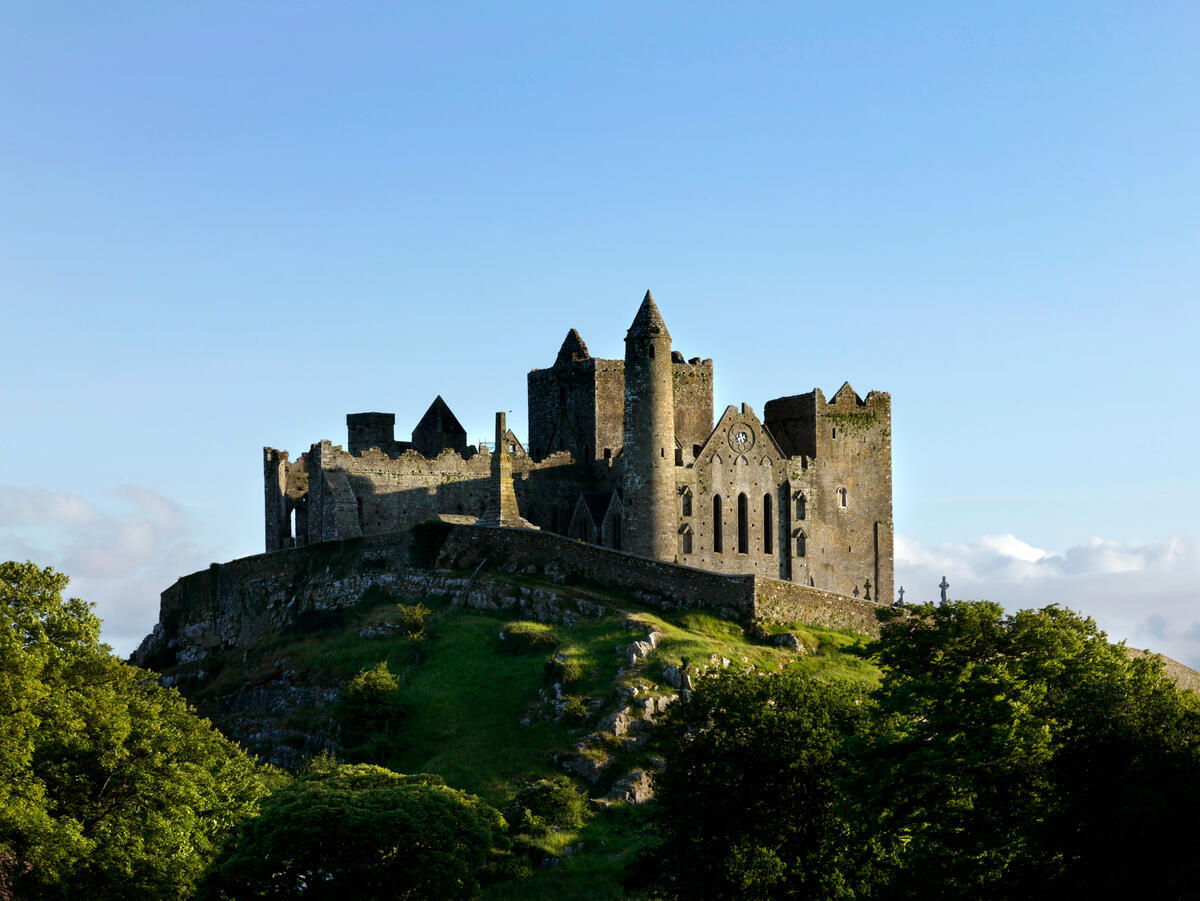
Few sites condense Irish history quite like the Rock of Cashel. The limestone outcrop rises sixty metres above the plain of County Tipperary and was the seat of the kings of Munster from around the fourth century — including, by tradition, the high king Brian Boru, crowned here in 978. In 1101 King Muirchertach Ua Briain granted the rock to the church, and it became one of the most important ecclesiastical centres in medieval Ireland. The buildings that survive on the summit today are remarkable: a 28-metre round tower from around 1100, the roofless Gothic cathedral built between 1235 and 1270, the 15th-century Hall of the Vicars Choral, and — at the heart of the complex — Cormac's Chapel, consecrated in 1134 and the finest surviving example of Hiberno-Romanesque architecture in the country, with rare twelfth-century frescoes still visible inside. It is managed today by the Office of Public Works and is one of the most-visited heritage sites in Ireland.
Waterford and the Viking Triangle
Waterford is the oldest city in Ireland. Founded as Veðrafjǫrðr by Viking settlers in 914, it has been continuously inhabited ever since — more than 1,100 years. The compact medieval core, now branded as the Viking Triangle, contains three small but exceptional museums: Reginald's Tower, the oldest civic urban building in Ireland and the only one to still bear its Viking name; the Medieval Museum, built around a 13th-century wine vault and a 15th-century choristers' hall; and the Bishop's Palace, a Georgian mansion housing the city's later collections including the earliest piece of Waterford Crystal, made in 1789.
Along the County Waterford coast, the Copper Coast UNESCO Global Geopark stretches twenty-five kilometres from Kilfarrasy to Stradbally, a sequence of small coves, sea stacks and 19th-century copper-mining ruins set into 460-million-year-old volcanic rock.
Cork: Ireland's Second City
Cork city grew up on a marshy island in the River Lee — the Irish name Corcaigh means "marsh" — and the centre still sits between two channels of the river. The English Market, trading on the same site since 1788, is one of the oldest covered food markets in Europe and remains the daily larder of the city. Just outside the centre, Blackrock Castle hosts an observatory and science centre; further afield, Cobh — the last port of call of the Titanic in April 1912 — preserves both the original White Star Line ticket office, now the Titanic Experience, and the cathedral of St Colman, designed by Pugin and Ashlin and one of the great Gothic Revival buildings in Ireland.
West Cork — from Kinsale through Clonakilty, Skibbereen and out to Mizen Head, the most southerly point of mainland Ireland — has become the country's most concentrated food destination, with a string of Michelin-listed restaurants and artisan producers from Gubbeen cheese to Glenilen dairy clustered along a coast of natural harbours.
Kerry: Mountains and the Atlantic
County Kerry holds the highest ground in Ireland — Carrauntoohil, at 1,038 metres, in the MacGillycuddy's Reeks — and three of its most iconic touring routes: the Ring of Kerry around the Iveragh Peninsula, the Dingle Peninsula with its Gaeltacht villages and beehive huts, and the Skellig Ring, with views of Skellig Michael, the UNESCO-listed sixth-century monastic island twelve kilometres offshore. Killarney National Park, established in 1932 as the first national park in the state, protects 102 square kilometres of native oakwood, the country's only wild herd of native red deer, and the three Lakes of Killarney.
Wexford and the Sunny South East
County Wexford promotes itself as the sunniest county in Ireland, and Met Éireann's long-term records broadly back the claim: Rosslare and the south-east coast consistently record the highest annual sunshine hours in the country. The Hook Peninsula holds Hook Lighthouse, in continuous operation since the 13th century and one of the oldest working lighthouses in the world. Inland, the Irish National Heritage Park outside Wexford town reconstructs 9,000 years of Irish settlement, and Johnstown Castle — a 19th-century Gothic Revival house set in 50 acres of gardens — reopened to the public in 2019 after a major restoration.
Practical Notes
Cork Airport is the region's main international gateway, with direct flights across Britain and Europe and connections to Boston in summer. Rosslare Europort in County Wexford offers daily car-ferry sailings to France and Wales. The M8 motorway puts Cashel within ninety minutes of Dublin and the M9 puts Waterford within two hours; Killarney and the Ring of Kerry are around four hours from the capital by car, or reached by direct rail to Killarney station.
The South and South East is the part of Ireland that rewards a slower itinerary. Cashel, Waterford, Cork, Killarney and the Mizen are each a day in themselves — and strung together they form one of the most coherent and historically dense touring regions in the country.