On a clear morning in early summer, standing at the cliff edge of Dún Aonghasa on Inis Mór, with the Atlantic opening out in every direction below you and nothing between you and North America but three thousand miles of open ocean, it is possible to feel something that is very difficult to name.
It is not merely the view — though the view is extraordinary, a semicircular stone fort perched on a cliff face that drops ninety metres straight into the sea, built by human hands more than three thousand years ago. It is something older than the fort itself. The sense of being at the edge of something. At the beginning of something. At the very edge of the known world.
This is what the Aran Islands do to people who actually make it there.
The question is why so few of them do.
Three Islands, Three Worlds
The Aran Islands — Inis Mór, Inis Meáin and Inis Oírr — sit in Galway Bay, a short ferry ride from the pier at Rossaveel or a seven-minute flight from Connemara Airport. They are accessible. They are not remote in any practical sense. And yet they receive a fraction of the visitor numbers that their extraordinary combination of history, culture, landscape and authenticity should attract.
Each island is distinct. Each repays a different kind of attention.
Inis Mór — the big island — is where most visitors go, and rightly so. At 31 square kilometres it is the largest and most varied of the three, with the prehistoric fort of Dún Aonghasa as its centrepiece and the eerie natural wonder of Poll na bPéist — a perfectly rectangular hole in the limestone connected directly to the sea, known as the Wormhole — as its most extraordinary secret.
The main village of Kilronan offers traditional pubs, local restaurants and the warmth of hospitality that feels unhurried and genuine in a way that is increasingly difficult to find in Ireland's more-visited destinations. Bicycles can be hired for a day's exploration of roads that wind through limestone pavements, past dry stone walls and ancient churches, with the sea always visible and always close.
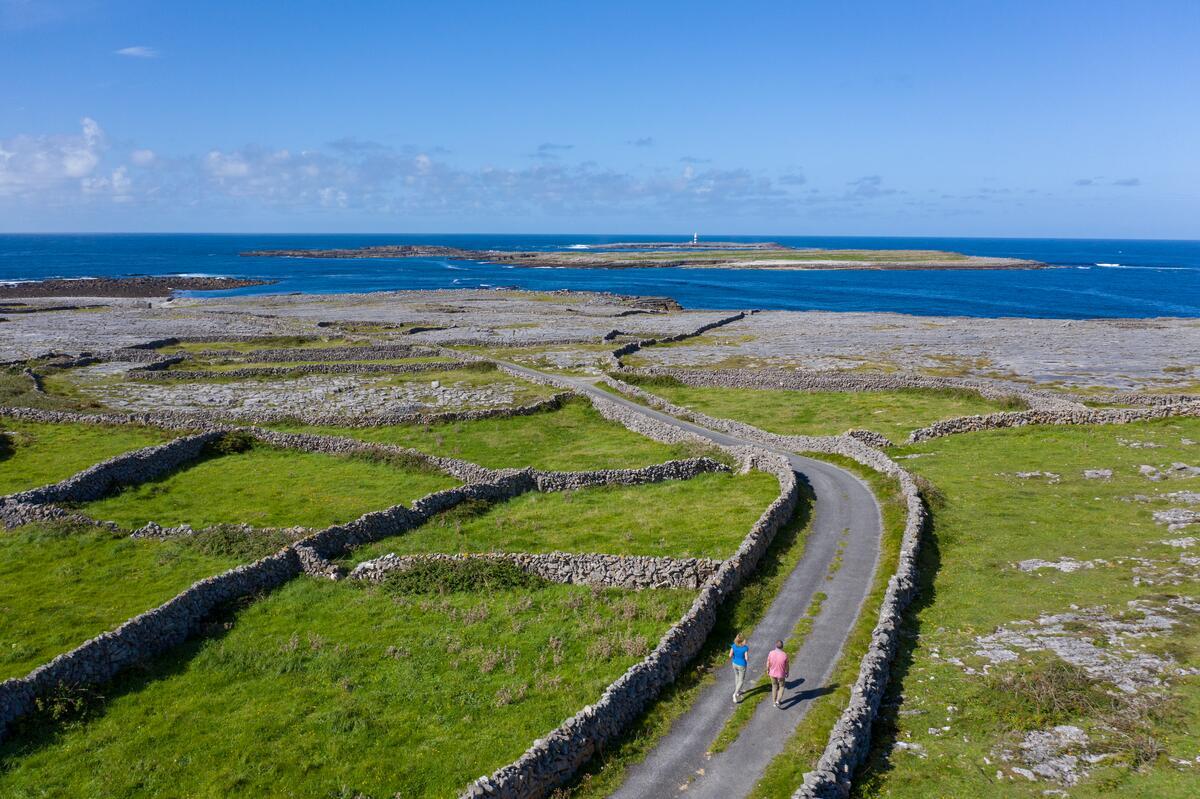
Inis Meáin — the middle island — is where time genuinely slows. Less visited than its sister islands, it offers the Aran experience in its most undiluted form. The landscape feels untouched. The silence is real. The stone walls that cross and recross the island like an ancient manuscript have been built and rebuilt by the same families for generations. At Inis Meáin Island Stays, a handful of beautifully designed stone cottages offer an overnight experience that feels entirely removed from the modern world — and yet is extraordinarily comfortable within it.
Inis Oírr — the smallest island — is, in many ways, the most affecting. A wrecked cargo ship rusting quietly on the beach. O'Brien's Castle rising above the village. St Caomhán's Church — dating from somewhere between the tenth and fourteenth century — half buried in sand in the island's graveyard. The ferry arrives, the island absorbs it, and life continues at its own pace.
Where History Lives in the Stone
The Aran Islands have been continuously inhabited for five thousand years. That is not a tourist board statistic — it is a physical reality that you encounter at every turn.
Dún Aonghasa was first constructed around 1100 BC, later re-fortified around 700 to 800 AD. The walk from the visitor centre to the fort takes fifteen to twenty-five minutes across limestone pavement, and the approach gives nothing away until the last moment — when the cliff edge and the full weight of what you are standing on suddenly becomes apparent.
The Seven Churches on Inis Mór — Teampall Bhreacáin — date from the eighth and ninth centuries and are among the most significant early Christian monastic sites in the west of Ireland. The carved stones that remain in the graveyard are extraordinary objects, worn smooth by Atlantic weather over more than a millennium but still legible, still present.
The islands are one of the last strongholds of the Irish language as a living vernacular. On Inis Meáin in particular, Irish is the language of daily life — not a performance for visitors, but the genuine voice of a community that has maintained its connection to the language through centuries during which it came close to disappearing entirely from Ireland.
The Films, the Writers, the Artists
The Aran Islands have always drawn creative people. Something about the quality of the light — the way it moves across limestone and sea with unusual speed and intensity — and something about the isolation and the deep time of the place has made it irresistible to artists, writers and filmmakers for more than a century.
J.M. Synge spent extended periods on the islands at the turn of the twentieth century, and his book The Aran Islands remains one of the finest pieces of Irish travel writing ever produced. The islands gave him the language, the characters and the atmosphere that he transformed into The Playboy of the Western World — one of the most celebrated plays in the Irish canon.
More recently, The Banshees of Inisherin — Martin McDonagh's Oscar-nominated film — introduced the islands' particular brand of windswept, ancient, darkly comic beauty to a global audience, and the resulting wave of visitor interest is only beginning to be felt.
What to Eat, Where to Stay
The Aran Islands have developed a quiet but genuine food culture built on the extraordinary natural larder that surrounds them.
Fresh Atlantic seafood — crab, lobster, mackerel — is available at restaurants and pubs across the islands, caught that morning by islanders who have been fishing these waters for generations. The Aran Islands Goat's Cheese, produced on Inis Mór, has developed a following far beyond the islands and is worth seeking out at source.
Teach Ósta on Inis Meáin transforms into a traditional music session on summer evenings — the kind of spontaneous, unselfconscious music-making that happens when musicians play for each other rather than for an audience, and that represents Irish traditional music at its most authentic.
For overnight accommodation, Inis Meáin Island Stays offers contemporary island living in stone cottages designed with genuine sensitivity to the landscape — eco-friendly, beautifully appointed and unlike anywhere else in Ireland.
On Inis Mór, several guesthouses and self-catering properties offer the chance to experience the island after the day-trippers have returned to the mainland — which is when the islands reveal their real character.
Getting There
Ferries to the Aran Islands depart from Rossaveel, approximately 40 kilometres west of Galway city, with year-round services operated by Aran Island Ferries. The crossing to Inis Mór takes approximately 40 minutes. Aer Árann Islands operates flights from Connemara Airport — a seven-minute crossing that offers one of the most dramatic views in Ireland.
The islands are busiest in July and August. May, June and September offer the best combination of good weather, manageable visitor numbers and the particular quality of late evening Atlantic light that makes the islands so compelling to photographers and painters.
The Bottom Line
The Aran Islands are not a day trip. They are not a box to tick on an Irish itinerary. They are a place that asks something of you — patience, slowness, a willingness to sit with an ancient landscape and let it work on you at its own pace.
For visitors who bring that willingness, the islands give something back that is genuinely rare in modern travel. A sense of place that is completely authentic. A connection to Irish history, language and culture that is living and unperformed. And a quality of beauty — limestone and sea and sky and silence — that lingers long after the ferry has returned to the mainland.
"Whether you're wandering through the ancient ruins on Inis Mór, immersing yourself in the quiet beauty of Inis Meáin, or retreating to the peaceful shores of Inis Oírr," wrote one recent visitor guide, "the islands offer a rare chance to slow down and experience the soul of Ireland in its most authentic form."
That is not an overstatement.