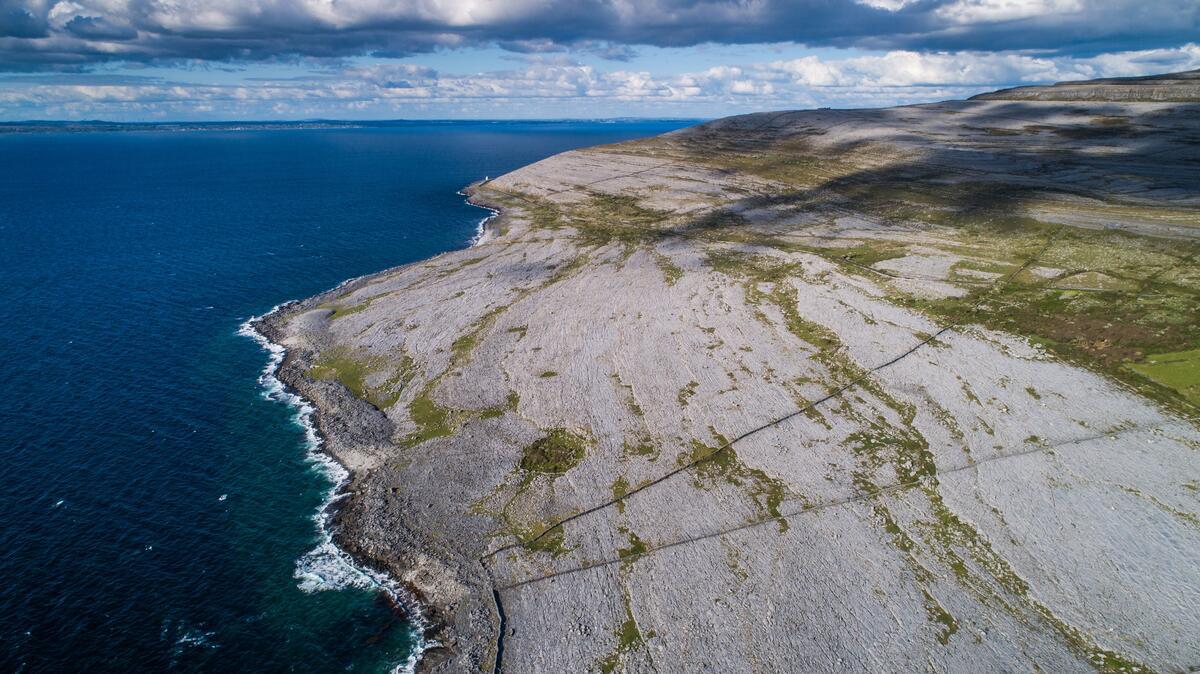
The name comes from the Irish Boireann, meaning "a rocky place." That is, on a literal level, accurate. The Burren is a plateau of bare carboniferous limestone in the north-west of County Clare — roughly 250 square kilometres of pavement, terrace and grike, formed in a tropical sea around 350 million years ago and scoured smooth by glaciers in the last ice age.
Together with the Cliffs of Moher to the south, it forms the Burren and Cliffs of Moher UNESCO Global Geopark, designated in 2011 and re-validated since. It is the only place in Europe where Arctic, Alpine and Mediterranean plant species share the same square metre — gentian, mountain avens and wild orchids growing side by side in the cracks of the limestone, fed by mild Atlantic winters and warm summer rock.
Why dawn matters
The Burren is one of Ireland's most-visited landscapes. By eleven o'clock in summer the tour coaches are parked at Poulnabrone dolmen, the visitor centres are filling, and the road from Ballyvaughan to Lisdoonvarna is a queue of camper vans. Before nine, almost none of that exists.
At first light, the limestone catches the low sun from the east and turns the colour of wet sand — pale, then gold, then white as the day climbs. The wind off Galway Bay drops. The wheatears and stonechats start calling from the stone walls. You can stand at Poulnabrone, a portal tomb dated to roughly 3,800 BC, and have a 5,800-year-old monument entirely to yourself.
A practical first-light route
Start before sunrise from Ballyvaughan on the north coast. Drive south on the R480 — the Caherconnell road — which climbs onto the limestone plateau within minutes. Pull in at Poulnabrone (free, open access, signposted). From there, continue south to Caherconnell stone fort and walk a short loop on the surrounding pavement.
Return north via Carron, where the floor of a turlough — a seasonal lake unique to Irish karst landscapes — fills and empties with the water table beneath the rock. By the time you reach Ballyvaughan again, the Roadside Tavern in Lisdoonvarna or An Fulacht Fia in Ballyvaughan will be open for breakfast.
What to bring, what to know
Sturdy boots — limestone pavement is uneven and the grikes (the cracks between the slabs) can be ankle-deep. A windproof layer; the wind off the Atlantic is constant even in June. Cash for the small honesty boxes at private heritage sites such as Caherconnell.
Stay on visible tracks where they exist — the Burren's flora is fragile, and the Geopark's "Leave No Trace" guidance is strict. Do not remove rocks, plants or fossils. The fossils alone are spectacular: corals and crinoids embedded in the pavement underfoot, deposits from the tropical sea that built this place.
The Burren in a wider arc
A first-light Burren visit pairs naturally with a coastal afternoon. The Cliffs of Moher are 30 minutes south; Doolin's traditional music sessions begin in the late afternoon; and the Aran Islands ferry sails from Doolin pier in summer — three of Ireland's most distinctive landscapes within an hour of each other, all part of the same UNESCO Geopark or its immediate hinterland.
For most of its history, the Burren was a place people drove past on the way to somewhere else. At dawn, with the limestone turning gold and nobody else on the road, it becomes very clear why it deserves its UNESCO listing — and why an early start is the single best decision a visitor to County Clare can make.