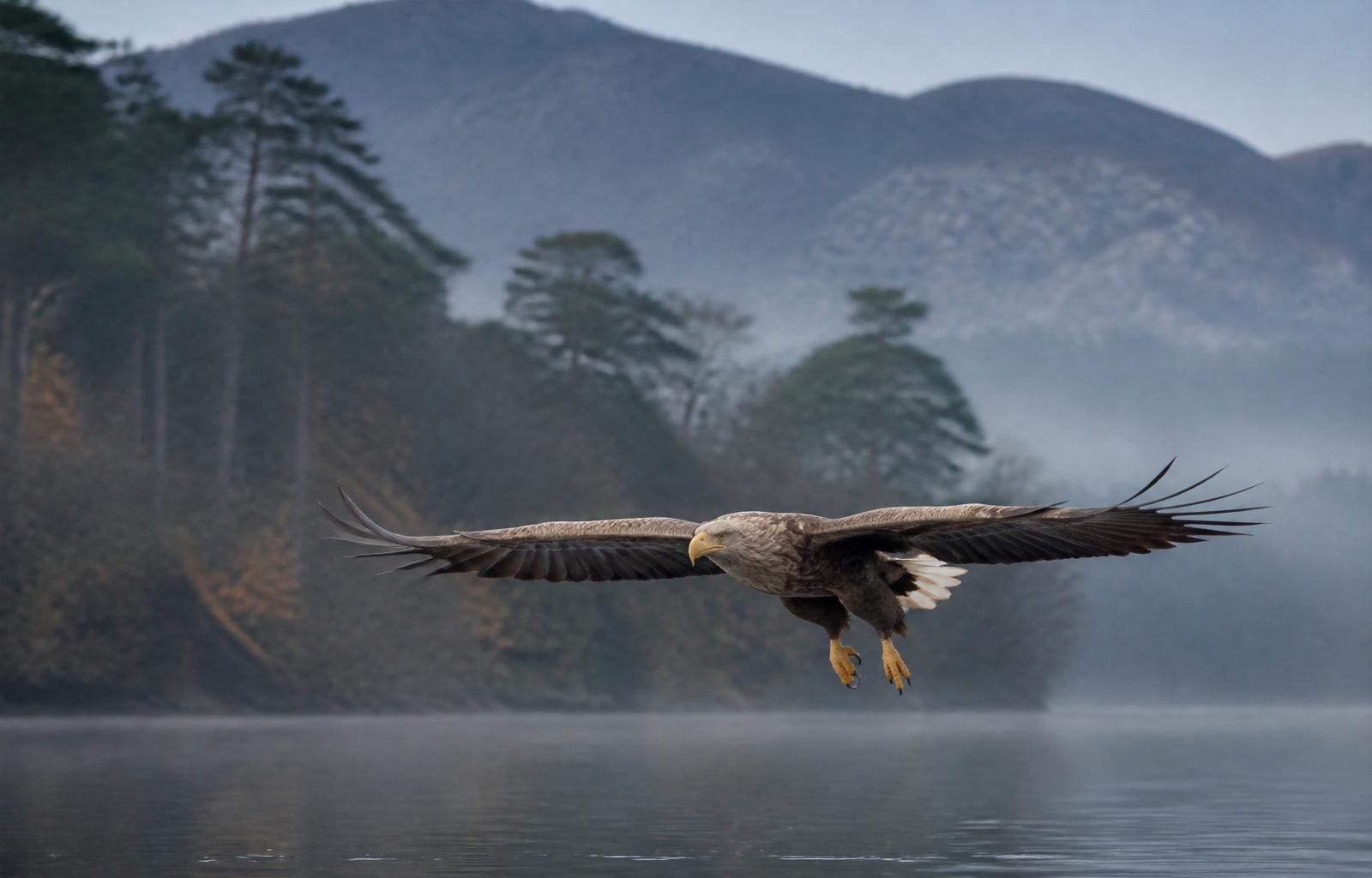
A Bird That Was Gone for Over a Century
The white-tailed eagle was once a permanent fixture of the Irish landscape. It soared over every coastline, nested along the shores of every major lake and river system, and occupied a place at the top of the food chain that nothing else filled. Then, across the 18th and 19th centuries, the combination of deliberate persecution — farmers, gamekeepers and hunters shooting them as a perceived threat to livestock — and habitat destruction eliminated them one nest at a time, until the last known wild pair bred in County Mayo in 1912, and then there were none.
For nearly a century, that was how it stayed. The white-tailed eagle — Haliaeetus albicilla, also known as the white-tailed sea eagle, the erne, or simply the sea eagle — existed in Ireland only in place names. The frequency with which the word "eagle" appears in Irish townland and landscape names across the west is a fossilised record of where they once lived, a linguistic haunting by a species that had been gone from the skies for generations.
The Reintroduction: How It Happened
In 2007, the National Parks and Wildlife Service began what would become one of the most significant wildlife conservation programmes in Irish history. Working with partners in Norway and with the Golden Eagle Trust, the NPWS brought young white-tailed eagle chicks to Killarney National Park in County Kerry, held them in purpose-built aviaries until they were ready to fly, fitted each one with satellite tags to track their movements, and then released them into the Killarney landscape that had once been their habitat. Between 2007 and 2011, 100 young eagles were released in this first phase, all sourced from Norway — the country with one of the largest and most stable white-tailed eagle populations in Europe — under strict licensing from the Norwegian Institute for Nature Research.
The programme did not produce immediate results. White-tailed eagles mature slowly, typically not breeding until they are four or five years old, and the early released birds spent years dispersing across Ireland before the conditions for successful breeding were in place. The first successful breeding in the programme's history occurred in 2012 — not in Killarney, but on Lough Derg in County Clare, where a pair raised chicks on an island nest. From that point, the population began to grow, slowly and with setbacks, but with a direction of travel that became increasingly clear.
In 2020, the NPWS began a second phase of the programme, releasing further chicks at multiple sites including Lough Derg, the lower Shannon estuary and Killarney National Park, to bolster the population and address concerns from a scientific review that the original population, while established, remained vulnerable. Eagles from Norway continued to arrive each year — flown to Kerry Airport, held in aviaries, satellite-tagged and released — until the programme reached its conclusion in August 2025, when the final cohort of chicks was released at Killarney National Park, bringing the total number of white-tailed eagles reintroduced to Ireland since 2007 to 245.
Where Things Stand in 2026
The numbers, when you look at them, are genuinely remarkable given where the species was a century ago. There are estimated to be approximately 150 individual white-tailed eagles in the wild across Ireland, a population considered large enough to be self-sustaining without further intervention. As of 2025, 17 known pairs were active, with 13 chicks fledged from 10 pairs in 2024. In Killarney National Park specifically, two chicks successfully fledged for the fourth year in a row in the year the programme concluded. At Lough Derg, a nesting pair fledged triplets — an event described by the NPWS's own divisional manager Eamonn Meskell as "incredibly unusual, even in the wilds of Norway."
The species has spread well beyond its original release sites. Eagles have been recorded in counties Cork, Kerry, Clare, Galway, Tipperary, Limerick, Waterford and further north along the Shannon. The first Irish-bred female to breed successfully in over a hundred years fledged seven chicks in three years — a milestone that barely merits a paragraph in programme reports but would have seemed extraordinary to anyone involved in the project's earliest years. The satellite tagging that has accompanied every release since 2007 provides a live picture of where these birds are at any given time, allowing the NPWS to track dispersal, identify territories and monitor survival rates across the entire national population.
What a White-Tailed Eagle Actually Looks Like
You need to understand the scale of this bird before you understand why seeing one stops people in their tracks. The white-tailed eagle has a wingspan of over two metres — just over six feet from wingtip to wingtip — and a body length of approximately one metre. Together with the Mute Swan, it is the largest resident bird species in Ireland. When it soars on thermals over Killarney's lakes, it is genuinely enormous: a broad, plank-shaped silhouette with a short wedge-shaped tail and massive, rectangular wings that distinguish it immediately from the more commonly seen buzzard, which shares the same airspace but occupies a different order of magnitude. The white tail itself — visible on adult birds from several years of age — is the definitive field mark, stark white against the brown body in direct sunlight.
Adult white-tailed eagles are generally silent away from the nest. They feed primarily on fish, which they catch after a spectacular plunge to the water surface — talons first, the huge body pulling up at the last moment before impact — and on carrion such as dead sheep or seals. They will occasionally take medium-sized mammals and seabirds from nesting sites. In Killarney National Park, the combination of the lakes, the old-growth oak and pine woodland that provides nesting habitat, and the relatively undisturbed character of the national park makes it close to ideal eagle territory. Eamonn Meskell of the NPWS has described the park as providing "the perfect nesting habitat, with its old, tall oak and pine trees, quiet surroundings and an ample supply of fish available in the lakes."
Where and How to See Them
Killarney National Park, covering 10,000 hectares across the lakes and mountains of north Kerry, is Ireland's oldest national park and the most reliable location in the country to see white-tailed eagles in the wild. The lakes — Lough Leane, Muckross Lake and Upper Lake — are the birds' primary hunting grounds, and eagle sightings are most common along the lake shores, particularly in the early morning and late afternoon when the light is low and fishing activity is highest.
The best approach is patience and positioning. Take a boat trip on the lakes — jaunting car operators and boat hire companies operate out of Killarney town — and spend time on or near the water rather than driving through. Binoculars are essential. A large, dark bird soaring high in the thermal above the oak woodland, with wings held flat and absolutely straight rather than in the buzzard's characteristic V-shape, is almost certainly an eagle. Once seen at close range, the scale of the bird makes the identification unmistakable.
The NPWS encourages members of the public to report sightings, which contribute to the ongoing monitoring of the national population. Locations of nesting pairs are deliberately not shared publicly — protecting active nests from disturbance is a priority given the continued vulnerability of the population to factors including illegal poisoning, avian influenza and electrocution on power lines — but the lakes and woodland of Killarney National Park remain the single best place in Ireland to encounter this bird in the wild, free, and doing exactly what it was doing here before anyone alive today was born.
The Bottom Line: The return of the white-tailed eagle to Ireland is one of the most genuinely moving conservation stories in modern Irish natural history — a species gone for over a century, brought back through eighteen years of patient, internationally collaborative work, and now established well enough that the programme that created the population can end. Killarney National Park is where it all started, and it remains the place where seeing one is most likely. Go prepared to wait. Go prepared to be surprised by the size of the thing when it arrives.