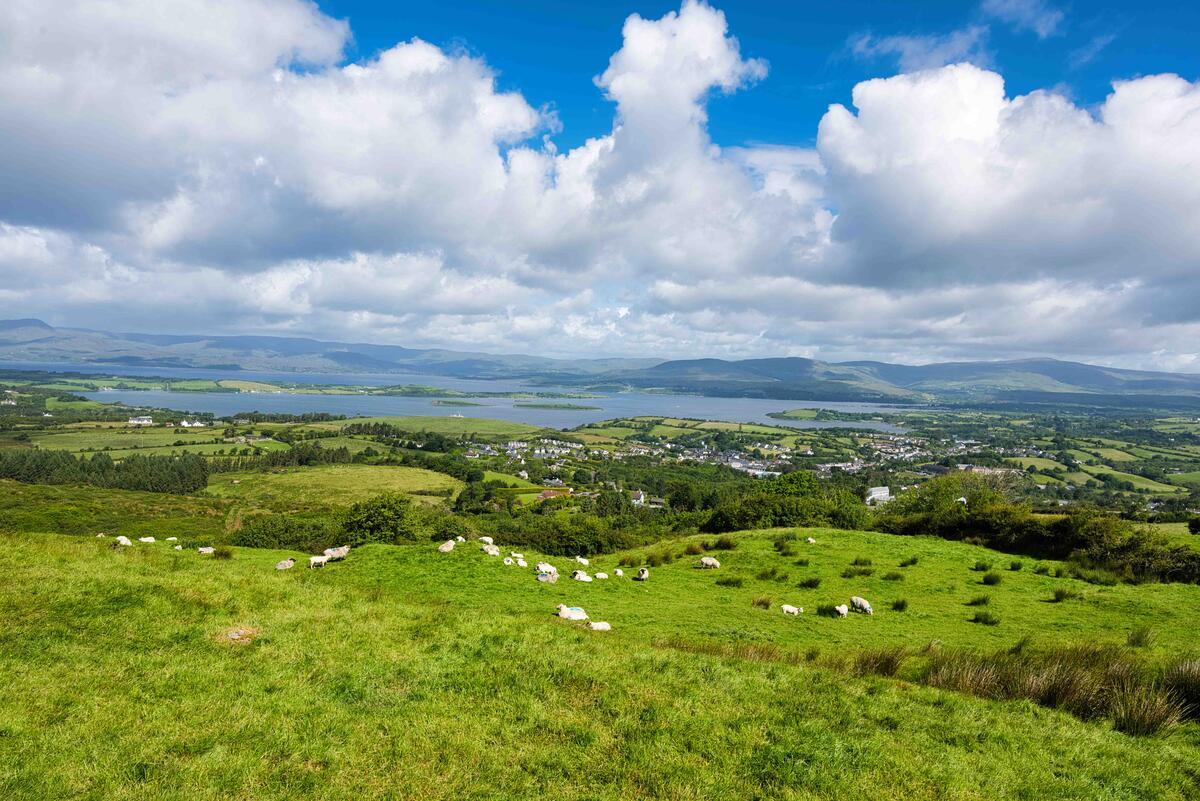
There are road trips, and then there is the Wild Atlantic Way.
Launched by Fáilte Ireland in 2014, the Wild Atlantic Way spans 2,500 kilometres of coastline from Donegal in the north to West Cork in the south — making it the longest coastal driving route in the world. It passes through nine counties, skirts the edges of a continent, and delivers a procession of landscapes so varied and so dramatic that no two days on the road look remotely alike.
For those beginning their journey from Dublin and making their way south and west toward Cork — picking up the route as it winds through Kerry, Clare and Galway — what follows is not merely a scenic drive. It is an immersion in the most elemental version of Ireland there is. Wind-carved cliffs. Forgotten stone villages. Peninsulas that jut defiantly into the Atlantic as though daring the ocean to do its worst.
This is where Ireland keeps its wildest self.
The Route — What to Know Before You Go
Divided into three main sections comprising 14 stages, it takes around 32 hours behind the wheel to complete the entire route — best spread across 11 to 14 days. For those travelling from Dublin south toward Cork and tracing the western coast on the way, a more relaxed approach of two weeks allows the journey to breathe — which is precisely how it deserves to be experienced.
The route can be followed using a unique collection of over 180 Discovery Points — signposted stops that guide travellers through both famous landmarks and the extraordinary hidden corners that make the Wild Atlantic Way so irreplaceable. The distinctive wave-shaped iron markers appear throughout the route, making navigation intuitive even on the most remote stretches of road.
A word of practical wisdom before you set out: driving two to four hours per day keeps the experience unhurried and gives you room for the spontaneous stops that become the most memorable parts of any journey along this route. Book accommodation in advance, particularly in summer. The roads narrow considerably the further west you travel. And the weather — famously unpredictable — should be treated not as an obstacle but as part of the character of the place.
County Cork — Where the Route Truly Begins
While Cork city itself does not sit on the official Wild Atlantic Way route, it is well-connected and serves as the perfect gateway to begin heading west. From the city, the road opens quickly into the extraordinary landscape of West Cork — a county that rewards slow travel more generously than almost anywhere else in Ireland.
Kinsale is the natural first stop. A vibrant harbour town bursting with colour, character and culinary flair, its winding streets, historic fortifications and renowned food scene make it one of the most charming and lively stops on Ireland's south coast. The town's reputation as Ireland's gourmet capital is hard-won and richly deserved — a meal here, in one of the narrow-streeted restaurants overlooking the harbour, is the perfect way to mark the beginning of the journey.
West of Kinsale, the landscape grows wilder by the mile. The Mizen Head Peninsula draws you to the most southerly point of the island — a signal station perched above crashing Atlantic waters, connected to the mainland by a suspension footbridge that sways gently above the surge below. Few places on the route announce the scale of what lies ahead quite so dramatically.
County Kerry — The Kingdom at Its Most Spectacular
Kerry is where the Wild Atlantic Way reaches its most celebrated heights — and justifiably so. The county contains some of the most extraordinary coastal scenery not merely in Ireland, but in Europe.
The Ring of Kerry — the circular route that winds around the Iveragh Peninsula — is among the great classic drives of the world. Killarney and the Ring of Kerry should be given at least two full days, such is the density of what the county offers. Killarney National Park — 26,000 acres of mountain, woodland and lake — provides a counterpoint to the coastal drama, its ancient oak woods and glittering loughs offering a different kind of beauty entirely.
The Dingle Peninsula, further north, is arguably the more intimate and rewarding experience. The Slea Head Drive winds along the edge of the Dingle Peninsula, delivering picture-perfect views at every turn — rolling green hills, dramatic cliffs, and the distant Blasket Islands visible across the water. The Great Blasket Island — uninhabited since 1953, visible from the headland at Slea Head — carries with it a melancholy and a beauty that is uniquely Irish. Dunmore Head on the Dingle Peninsula marks the westernmost point of Europe.
Dingle town itself is one of the great pleasures of the route — a working fishing port with a literary tradition, a music scene that spills out of its pubs nightly, and a quality of fresh seafood that reflects its relationship with the Atlantic at its most direct.
County Clare — The Cliffs That Stop the World
No stop on the Wild Atlantic Way produces the reaction that the Cliffs of Moher does. Some landscapes are simply beyond the capacity of prior expectation to contain.
The Cliffs of Moher extend for about eight miles along County Clare's Atlantic coast, rising to heights of more than 700 feet at their tallest point. Layers of shale and sandstone form dramatic vertical faces that drop straight into crashing waves below. They receive over one million visitors a year and are Ireland's most popular natural attraction. On a clear day, the Aran Islands are visible across the water, with the mountains of Connemara rising beyond them on the far shore of Galway Bay.
Go early in the morning — the crowds are thinner, the light is at its most extraordinary, and the experience of standing at the edge of Europe with nothing between you and America but three thousand miles of open ocean is one that deserves to be had in relative quiet.
The Burren — Clare's other world wonder — awaits nearby. A vast limestone plateau stretching across 250 square kilometres, it is one of the most unusual landscapes in Ireland — a place where Alpine flowers grow in the cracks of ancient stone, where prehistoric tombs punctuate the hillsides, and where the absence of colour somehow creates an atmosphere of profound beauty.
County Galway — The Wild Heart of the Route
Galway city — where the route pauses for breath before heading north — is one of the great small cities of Europe. Cobblestoned, colourful, humming with music and conversation, it offers everything a traveller needs to restore themselves before the road continues.
Beyond the city, Connemara begins. Connemara National Park spans nearly 3,000 hectares of mountains, bogs, heaths and grasslands in northwest Galway. The park is home to the Twelve Bens mountain range, whose quartzite peaks rise sharply above a patchwork of moorland and lakes. Native Connemara ponies move across the landscape with the casual ease of animals that have always belonged here. The Sky Road — a loop road above Clifden — delivers what many experienced travellers consider the single most spectacular view of the entire Wild Atlantic Way.
Kylemore Abbey — a Victorian castle built on the shores of a mountain lake, now home to a Benedictine monastery — is as close as Ireland comes to an unexpected fairy tale in stone. It should not be missed.
The Philosophy of the Journey
What the Wild Atlantic Way demands — and rewards — above all else is a willingness to surrender to it. To resist the impulse to cover ground and instead to stop when something catches the eye, to take the turning that looks interesting, to sit at the bar of a pub in a village whose name you weren't looking for and find yourself an hour deep in conversation with the person beside you.
Ireland's west coast has been shaped by forces larger than human ambition — by the Atlantic, by centuries of wind and rain, by the peculiar quality of the light that exists here and nowhere else on earth. The Wild Atlantic Way does not simply show you that coast. It immerses you in it.
From Dublin to Cork, with the Atlantic on your left and everything you thought you knew about landscape quietly revised — this is Ireland at its most irreducible, and its most magnificent.
The Bottom Line
The Wild Atlantic Way is one of the great journeys of the world. Not because of any single moment, but because of the accumulation of them — the cliffs and the coves, the villages and the peninsulas, the light on the water and the music in the pubs. Start in Dublin. End in Cork. Take your time. Ireland will do the rest.